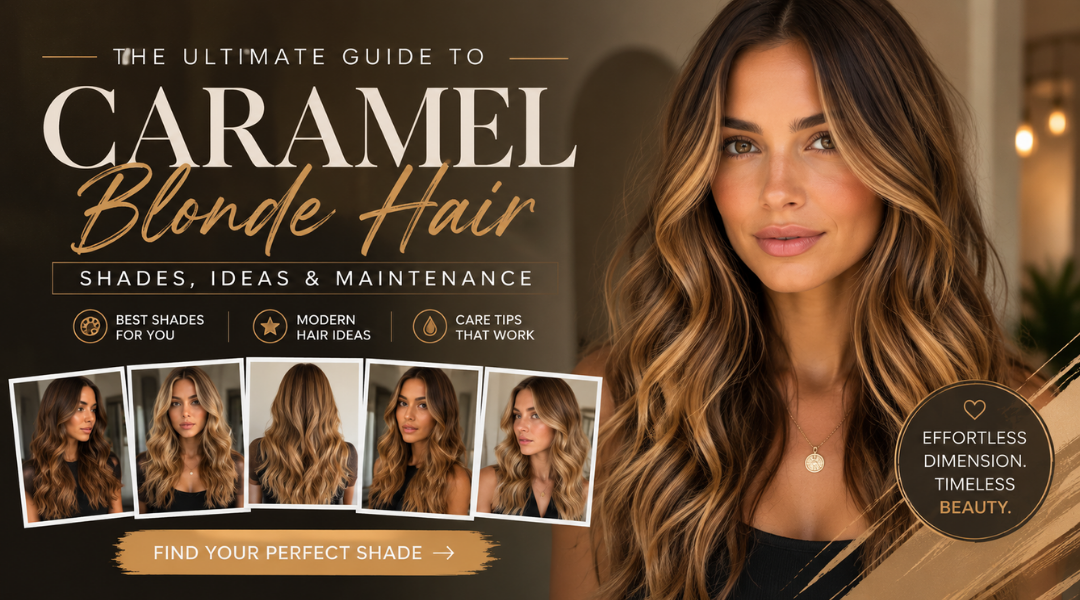
The warm-toned color family that’s easier to get wrong than most people think — and stunning when it’s right. Here’s everything you actually need to know.
What Is Caramel Blonde, Really?
Walk into any salon with a screenshot of “caramel blonde” and the first question is always the same: which caramel blonde?
Try before you dye
Caramel blonde is easier to get wrong than people think. Try it on your own hair first — free, no signup, nothing uploaded.
If you’re still deciding which caramel blonde is yours, start with our caramel hair color guide.
Because this isn’t one color. It’s a warm-toned family that spans from deep toasted brunette-blonde to bright, buttery golden blonde with amber undertones. The common thread is warmth — caramel blonde always leans golden, never ashy, never icy. But within that warmth, the range is wider than most people expect.
The simplest orientation: caramel blonde sits between honey blonde (lighter, more yellow-gold) and bronde (darker, more brown-dominant). It’s the sweet spot where brown and blonde stop competing and start blending — and that dimensional quality is exactly what makes a good caramel look expensive.
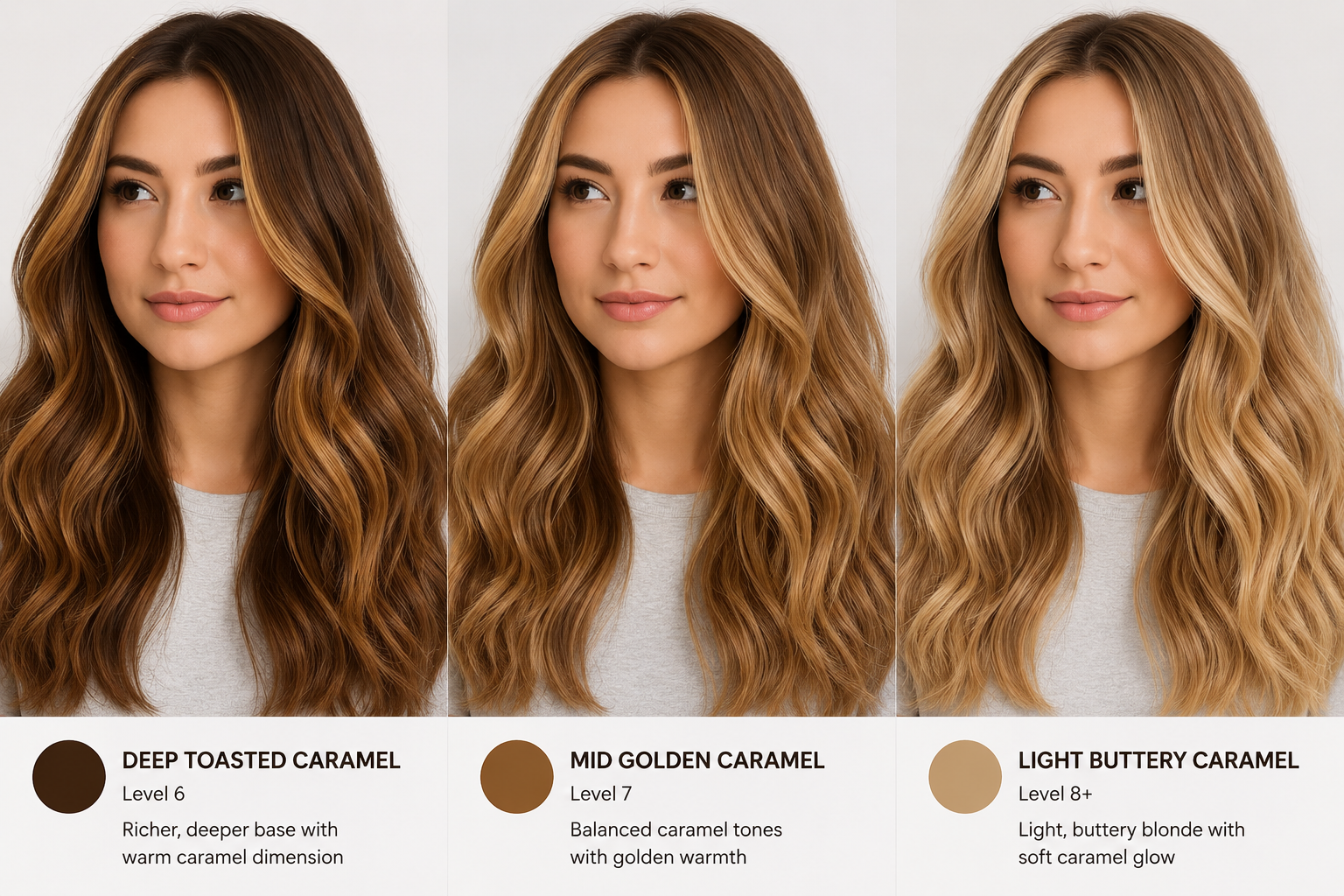
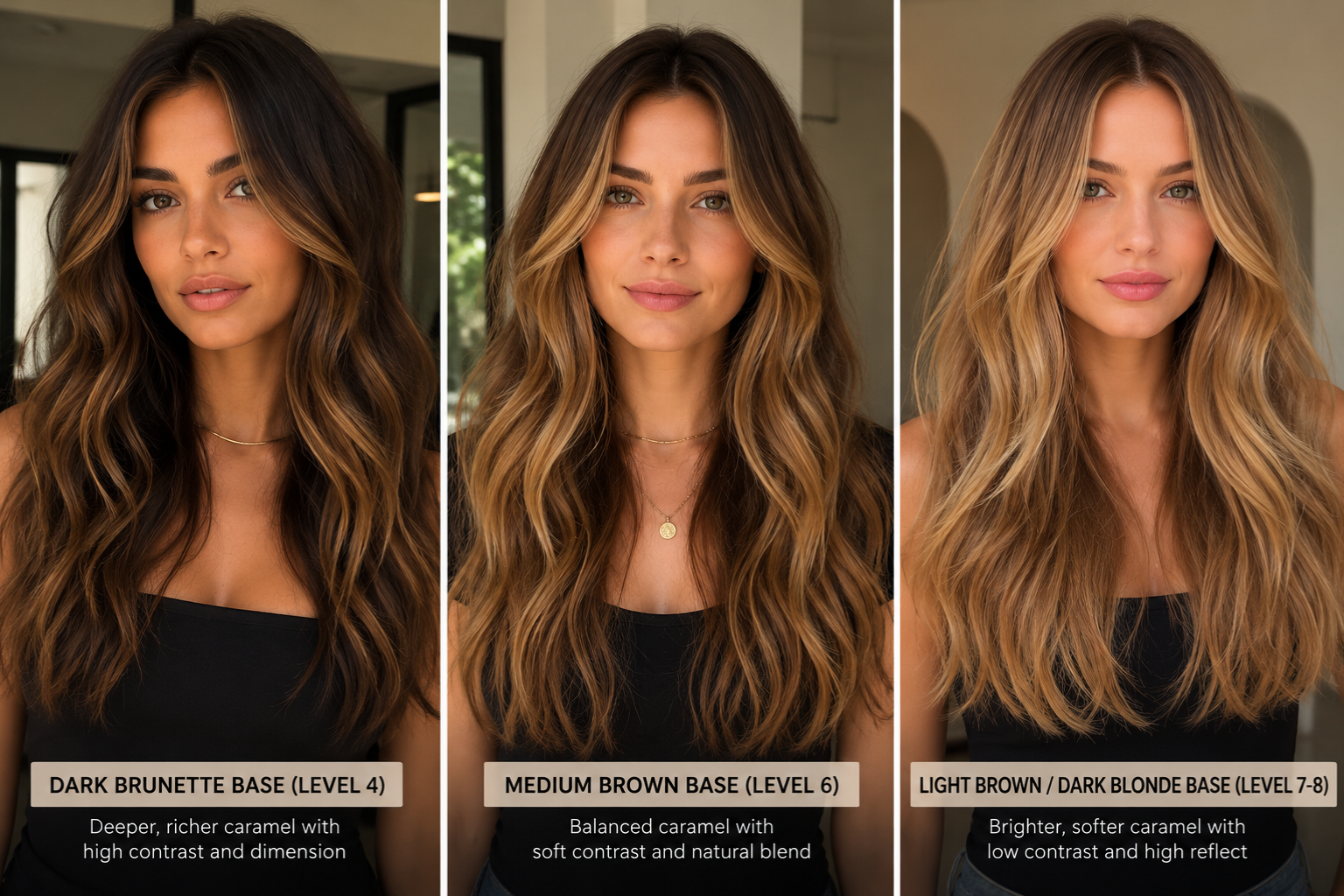
When clients say “caramel”, colorists mentally translate that into a level range (roughly 6–8) and a tone direction like gold, beige-gold, or copper-gold.
Bring reference photos that show the depth you want, not just the warmth. One photo usually isn’t enough. Bring three.
Caramel Blonde Hair Ideas & Looks
Before the process talk, the inspiration. This is what people are actually searching for — the named looks, the aesthetics, the “yes, that’s exactly what I want” moment.
If you want to explore the full range of caramel shades beyond blonde, browse our caramel hair color ideas guide.
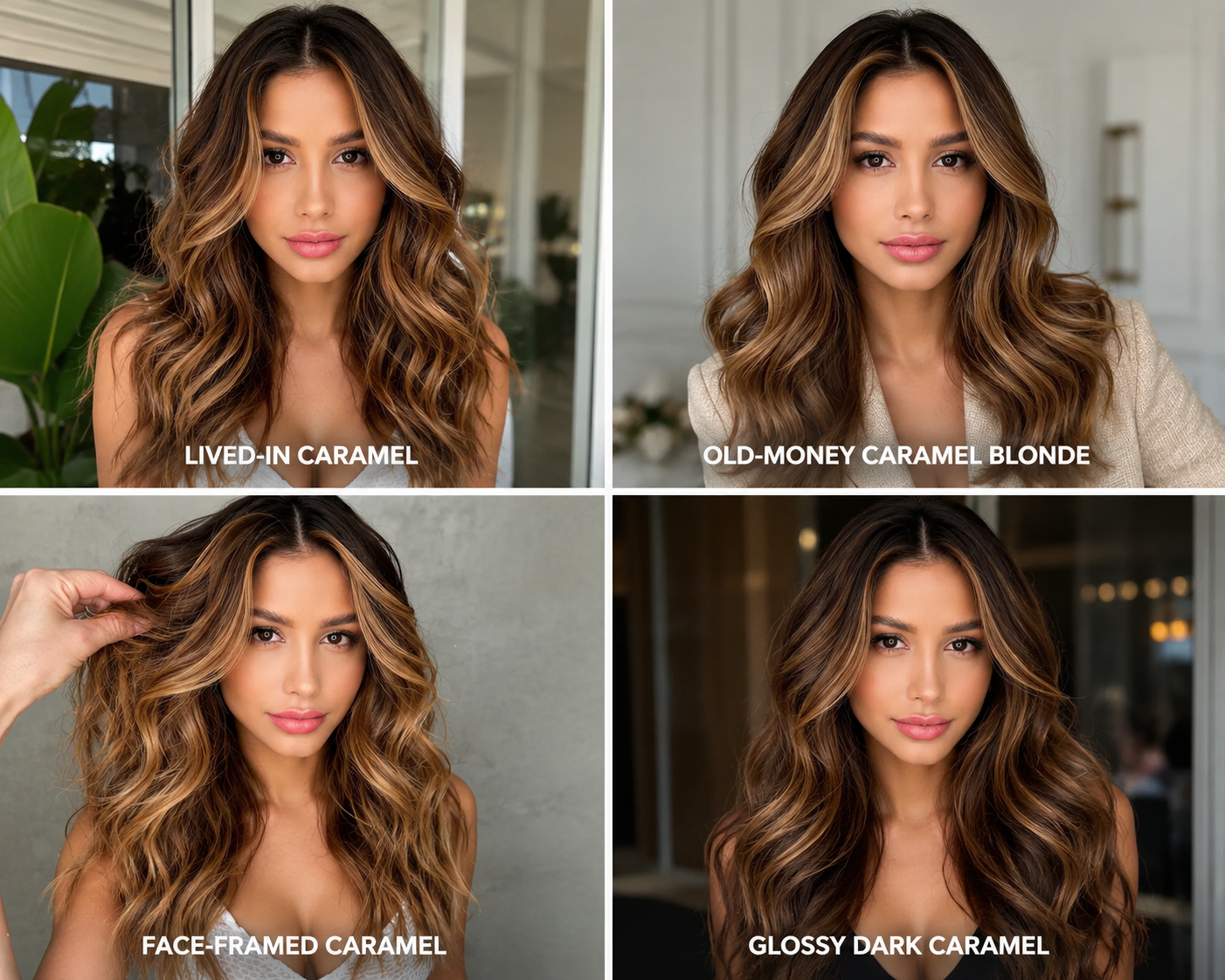
Lived-In Caramel Blonde
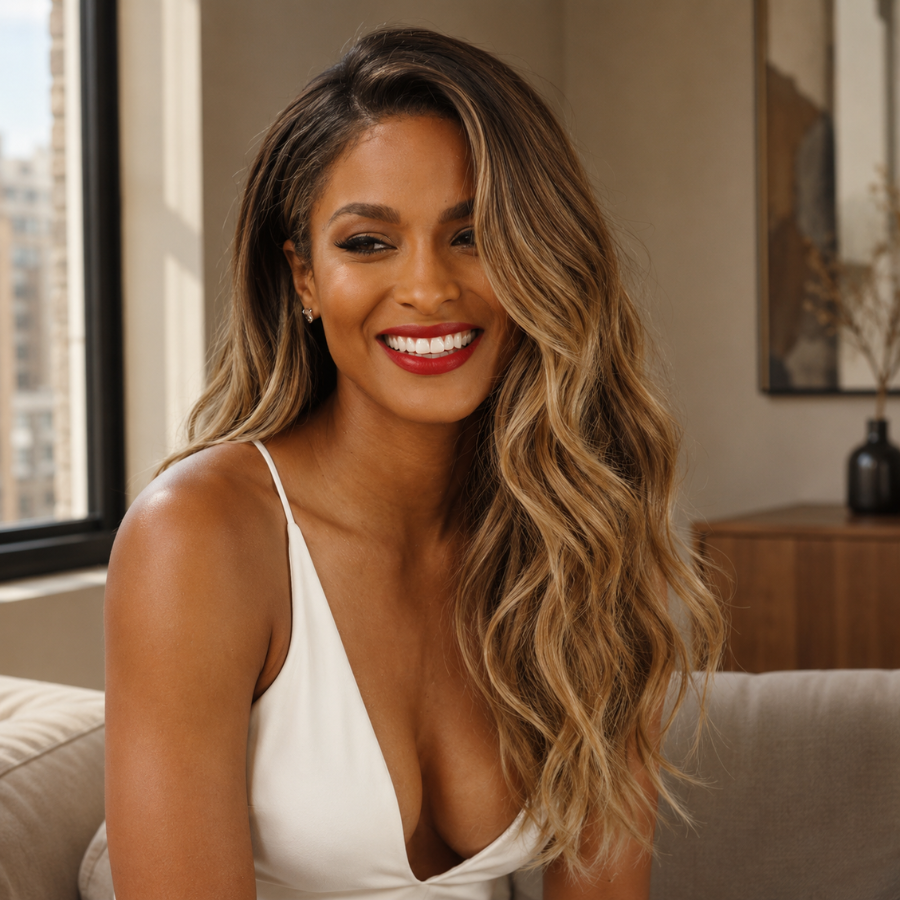
Maintenance: Low · Best for: Medium-dark bases
Soft root melt, warm mid-lengths, sun-faded ends. Looks like you were blonde for a year and the summer took over. The grow-out is the point — not a mistake.
Old-Money Caramel Blonde
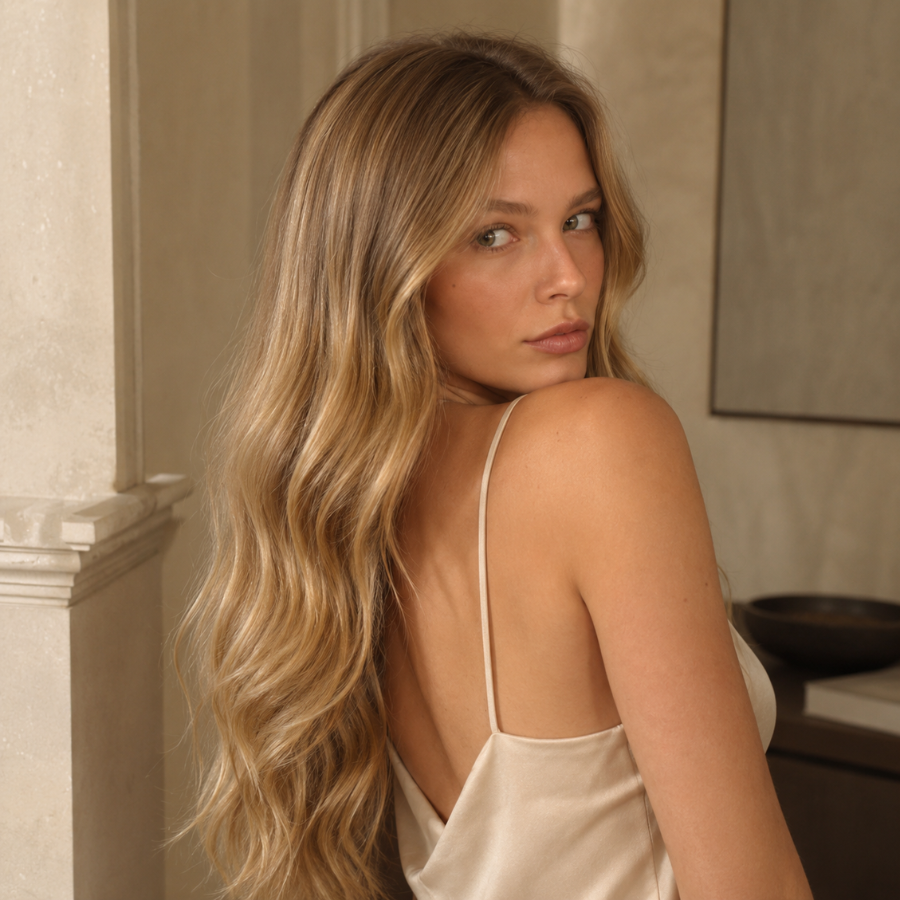
Maintenance: Moderate · Best for: Level 6–8 bases
Beige-gold tone, barely-there dimension, nothing that screams “just colored.” Polished without being obvious. The kind of color people ask about in passing because they can’t quite tell if it’s natural.
Face-Framed Caramel Blonde
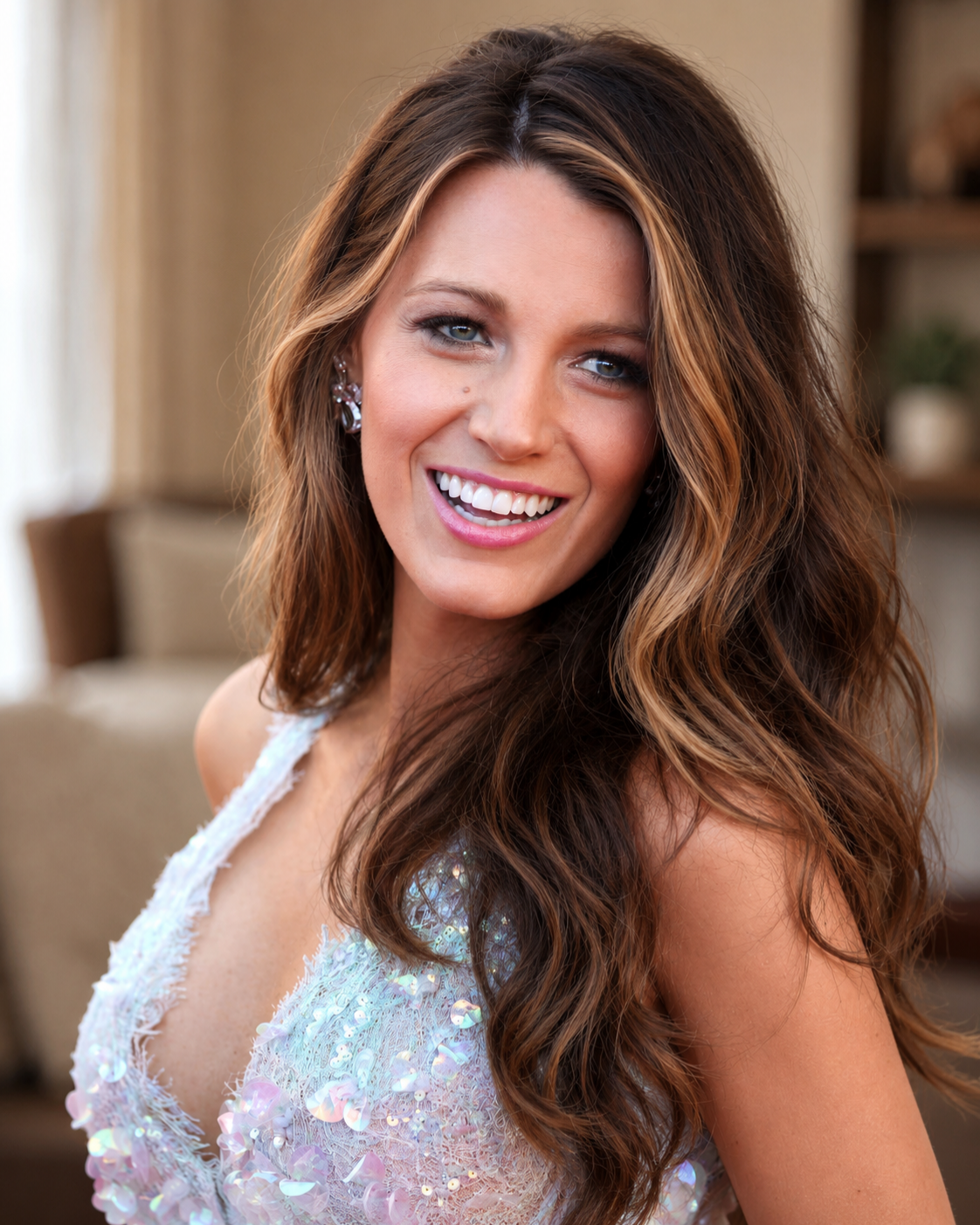
Maintenance: Moderate · Best for: Darker bases wanting warmth without all-over lift
Lighter, brighter caramel concentrated around the face against a deeper body. Frames the complexion without the commitment of all-over highlights. A good first step for brunettes.
Glossy Dark Caramel Blonde
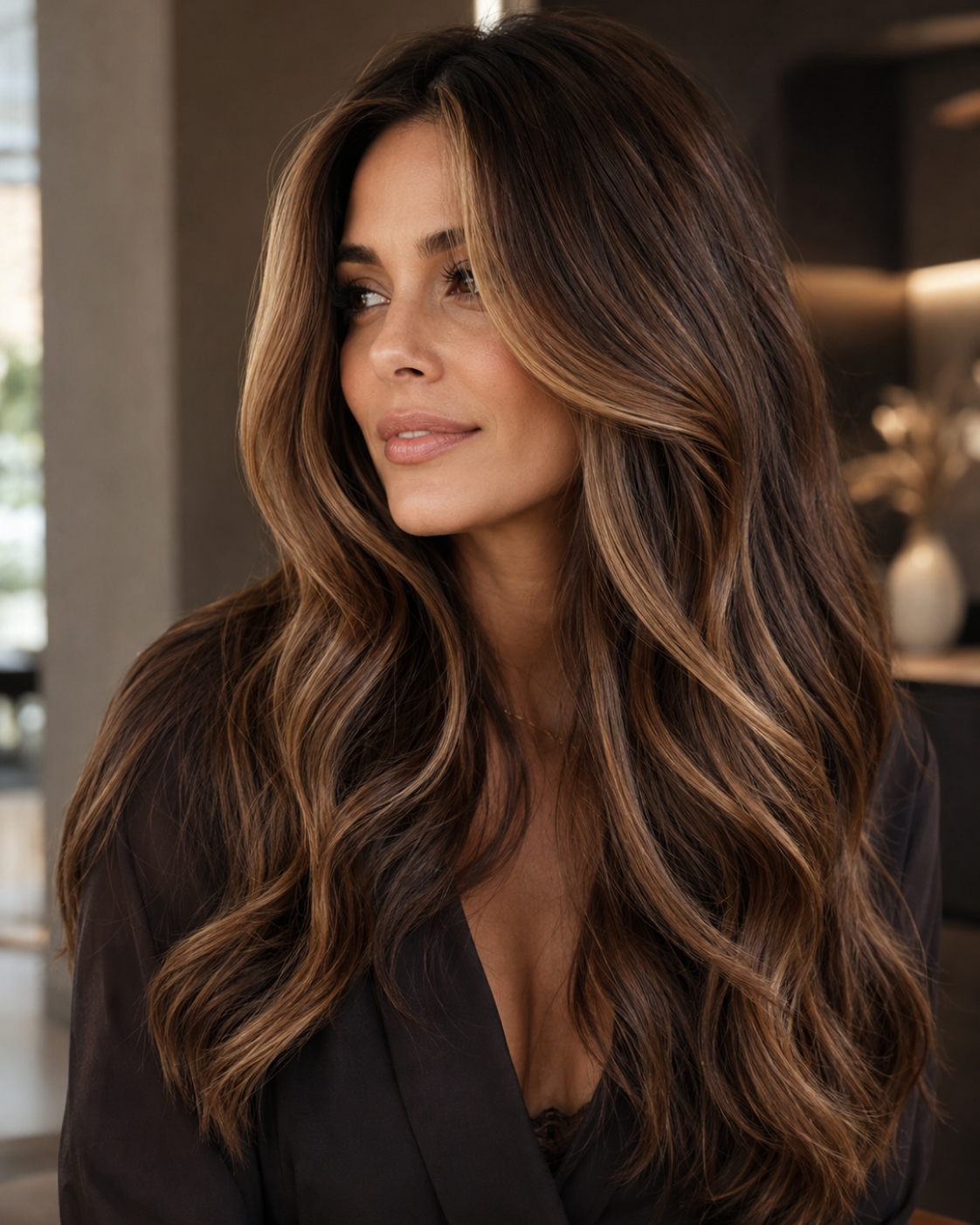
Maintenance: Low · Best for: Level 5–6 bases, bronde-curious
Deep, lacquered, rich — closer to bronde than blonde but with unmistakable golden warmth. Looks expensive indoors. Photographs even better outdoors. The low-maintenance move for dark hair.
Sunlit Caramel Blonde
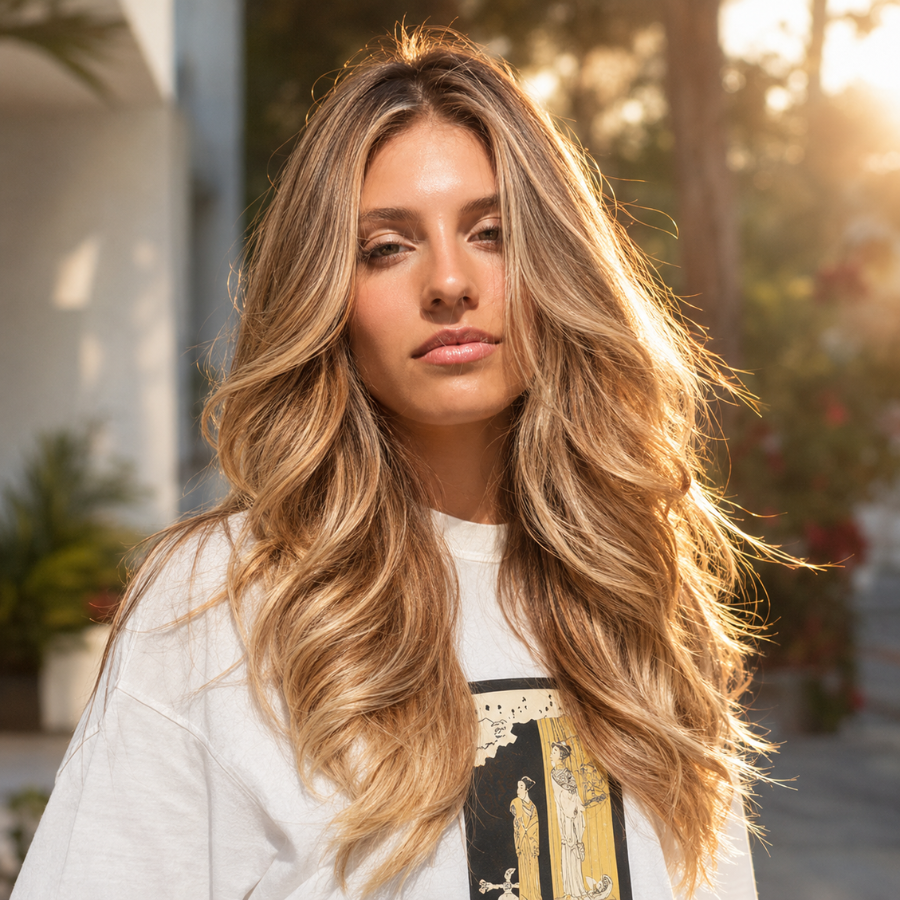
Maintenance: Higher · Best for: Light brown or dark blonde bases
Bright golden-caramel with visible contrast between root depth and luminous ends. The aspirational version. Stunning. Requires commitment — expect gloss refreshes every 6 weeks.
Soft Rooted Caramel
Maintenance: Low-Moderate · Best for: Anyone wanting longer intervals between appointments
A deliberate shadow root — 1–2 inches of deeper color at the scalp — melting into caramel warmth below. Grow-out grace built in from day one. The look that still looks good at week 14.
Caramel Blonde Balayage Ideas
Balayage is the dominant technique for caramel blonde right now — and for good reason. It grows out softer than foils, produces more natural-looking movement, and avoids the harsh grow-out line that made highlights in the early 2000s look so dated.
But “caramel balayage” isn’t one thing either. The placement changes everything.
Scattered Caramel Balayage
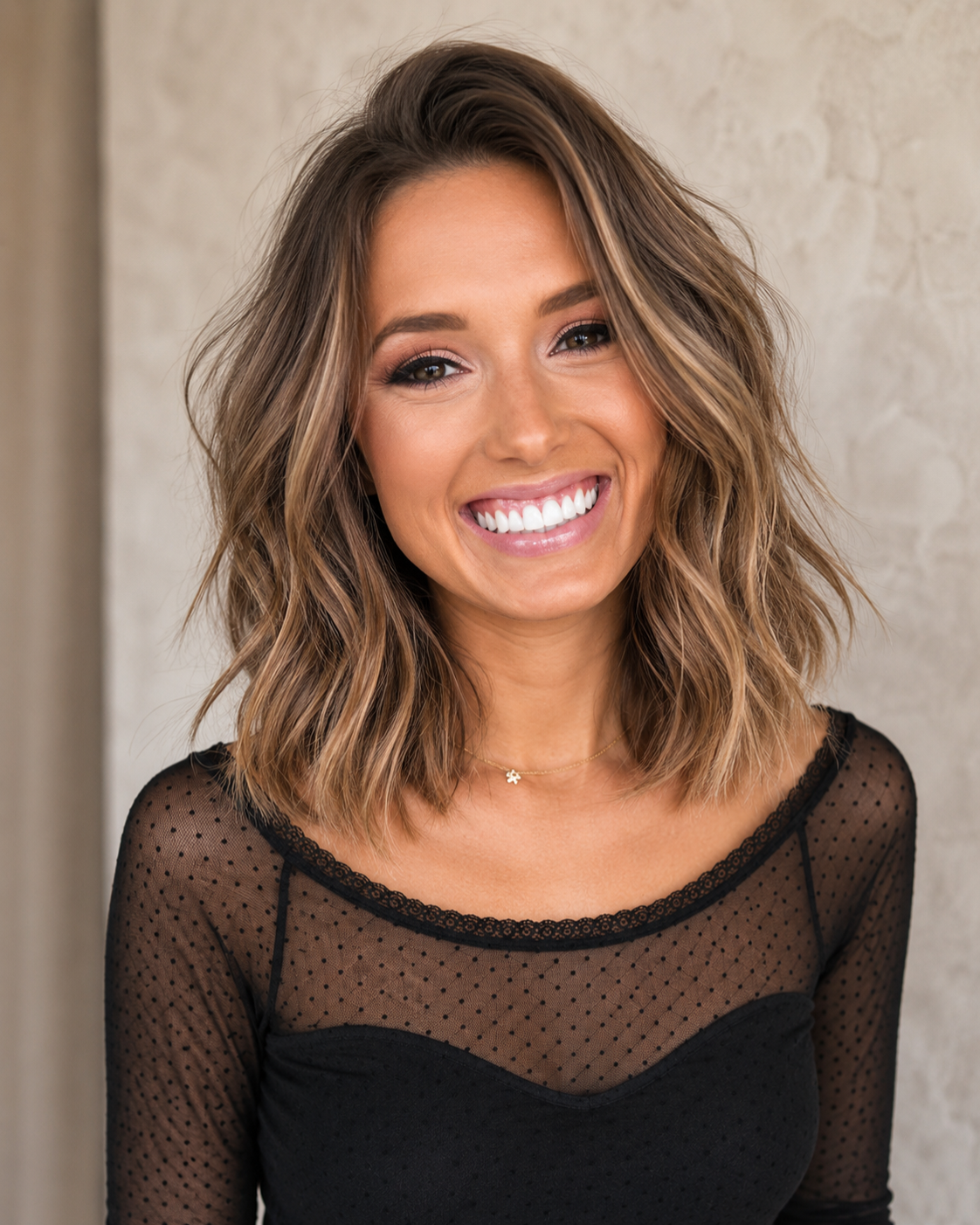
Light, diffused brushstrokes through the lengths — not concentrated anywhere, just everywhere. Gives an all-over sun-kissed warmth without obvious highlights. Best on medium-brown bases that need dimension, not drama.
Concentrated Face-Frame Balayage
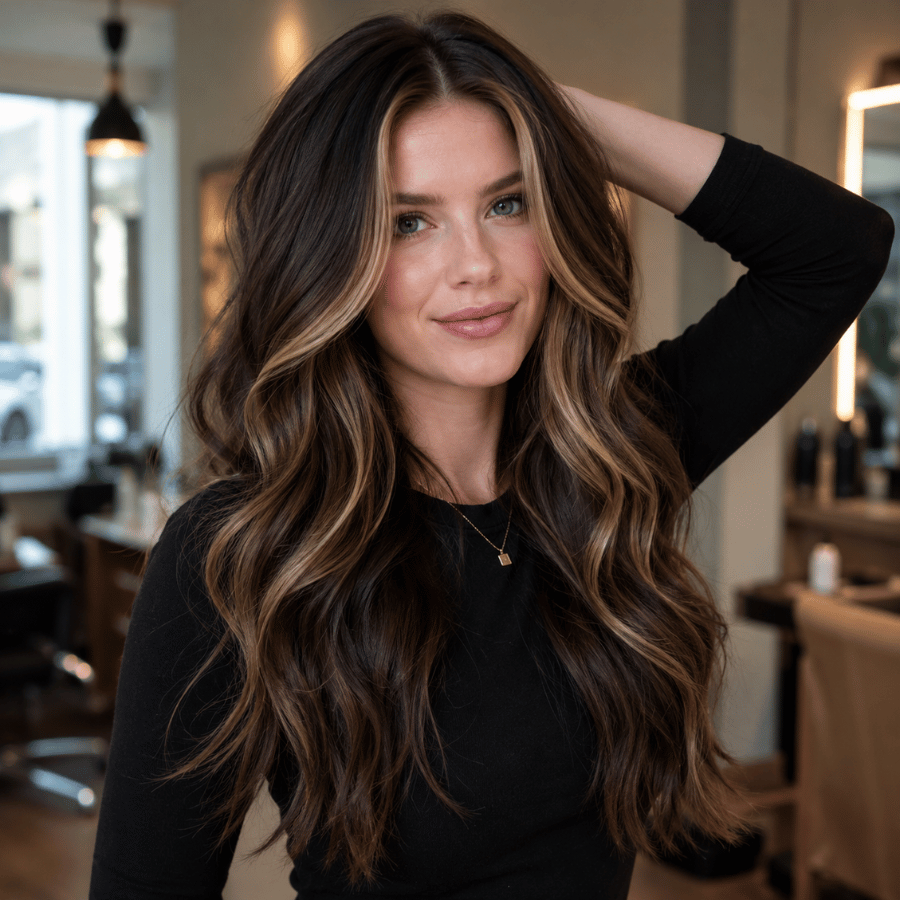
Heavier balayage around the perimeter and face, lighter saturation underneath. Flatters the complexion immediately. A good entry point for dark-haired clients — the contrast is visible without requiring a full lift through the body.
High-Contrast Caramel Balayage
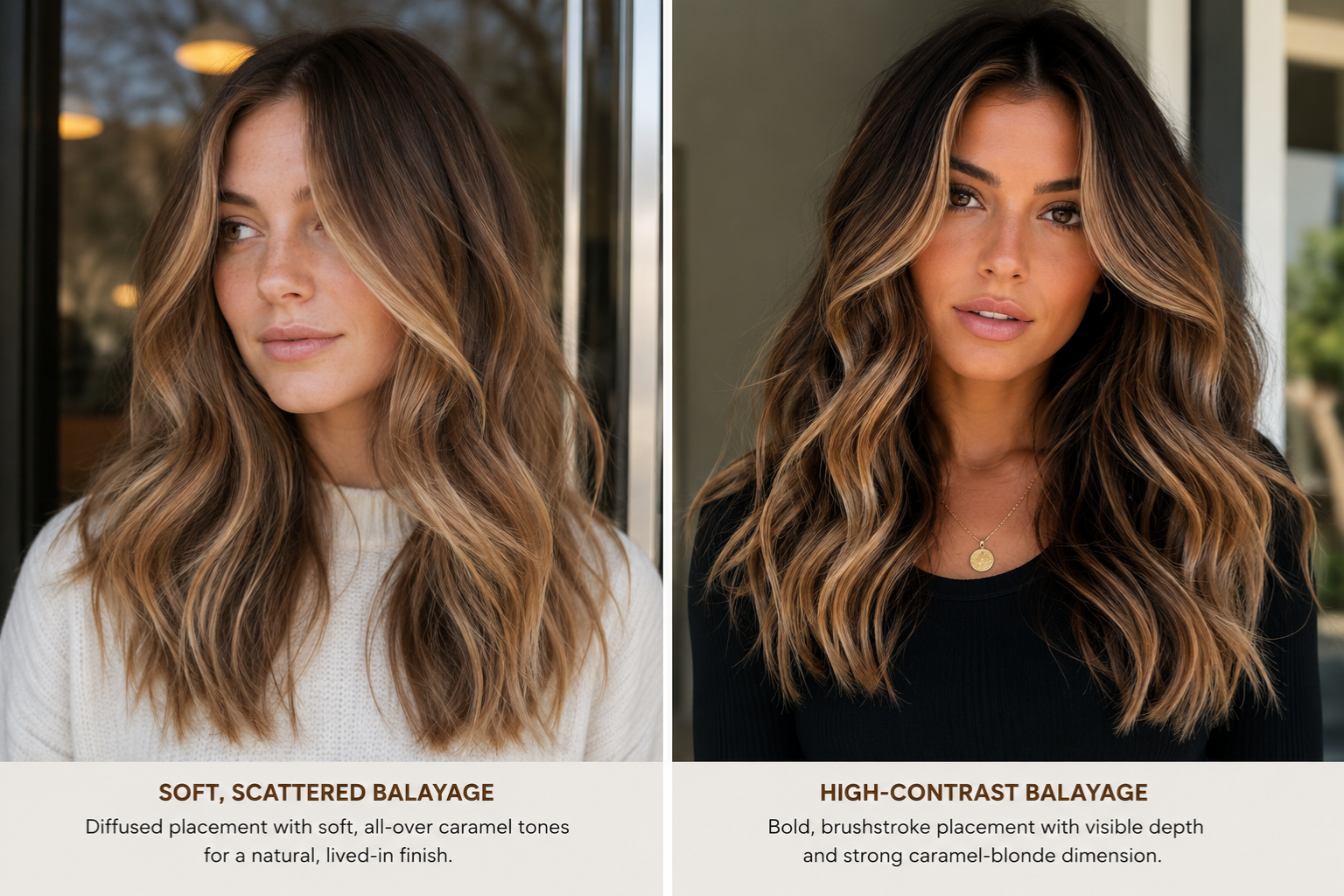
Deeper root, brighter caramel through the ends — a bigger jump between base and highlight. More visual impact, more maintenance, more dramatic. Best on thick or coarse hair where subtle placement disappears.
Caramel Balayage with Lowlights
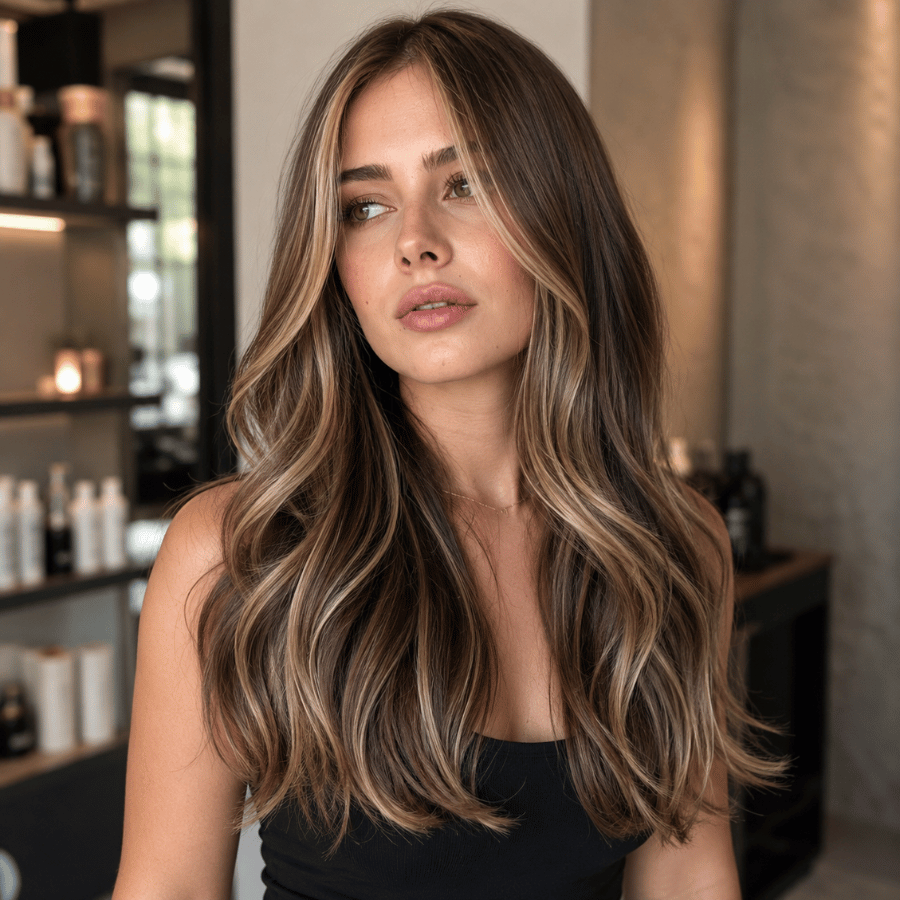
The depth version. Balayage lifted caramel, lowlights added back in to create shadow between the bright pieces. Gives movement and dimension even on straight, flat hair. Extends color life because the darker pieces anchor the eye even as lighter sections fade.
Who Does Caramel Blonde Work For?
Caramel blonde is one of the more forgiving warm tones — it stays popular because it genuinely works across a wide range of complexions. But “works” doesn’t mean it looks identical on everyone. And if caramel blonde feels too safe, the bolder burgundy shade guide might be your actual match.
Warm undertones (golden, peachy, olive): Caramel reads seamlessly. The warmth in the hair echoes the warmth in the skin. It feels like a natural extension rather than a color sitting on top.
Neutral undertones: Still works well, especially when the caramel leans beige-gold rather than copper-gold. Polished without being overly warm.
Cool undertones (pink, blue-red): Caramel can still work, but tone choice matters more. A golden or amber caramel can create an orangey cast around the face. The fix: pull the tone slightly toward a cooler beige-caramel. If your skin has strong pink or ruddy undertones, you might actually prefer a mushroom bronde — it calms the complexion instead of heating it up.
Curious how undertone plays into the broader picture? It’s worth exploring which hair colors genuinely complement your features before committing to a warm tone.
Caramel Blonde by Starting Hair Color
This is the section most articles skip. It’s also the one that matters most. Your starting hair color changes everything about the process, the result, and the maintenance schedule.
On Dark Brown or Black Hair (Level 2–4)
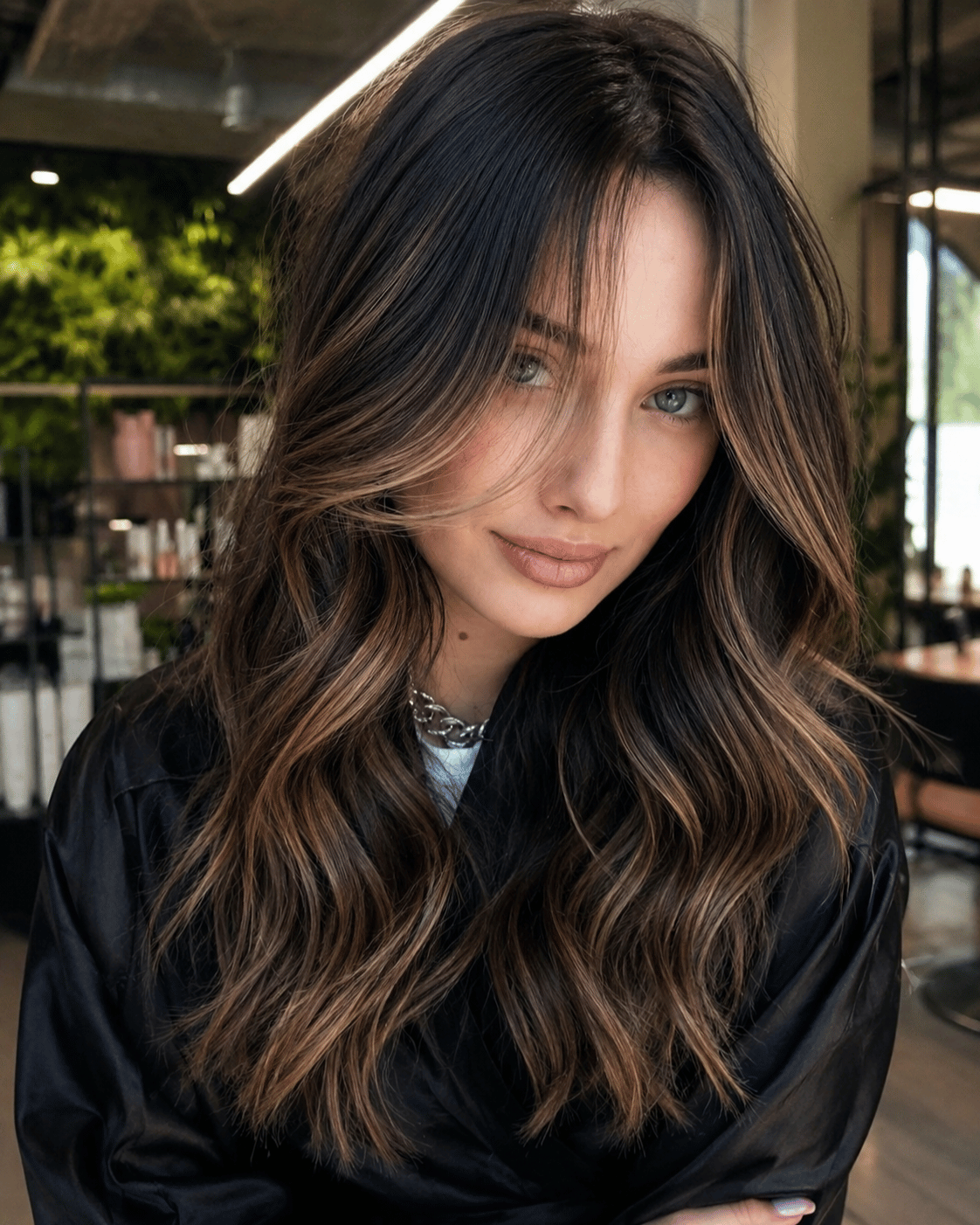
Let’s be honest: this isn’t a one-appointment transformation.
Very dark hair needs to pass through underlying warm pigments before reaching caramel territory — red, then orange, then gold, then yellow. If the lift stops too early, you get copper or orange, not caramel. This is the most common disappointment: the image someone saved was on a light brown base, not a level 3.
The realistic approach on dark hair is caramel highlights or caramel balayage against your natural depth — not an all-over lift. The contrast looks intentional, protects the hair, and grows out without a harsh line.
First sessions on level 2–4 hair typically take 3–4 hours, especially if you’re lifting dark hair into caramel territory for the first time.
Budget time, patience, and realistic expectations alongside the appointment cost. Healthy caramel blonde usually happens in stages, not one aggressive session.
If your colorist recommends coming back for a second session to refine the tone, that’s not upselling. It’s usually the safest way to protect the integrity of your hair.
On Medium Brown Hair (Level 5–6)
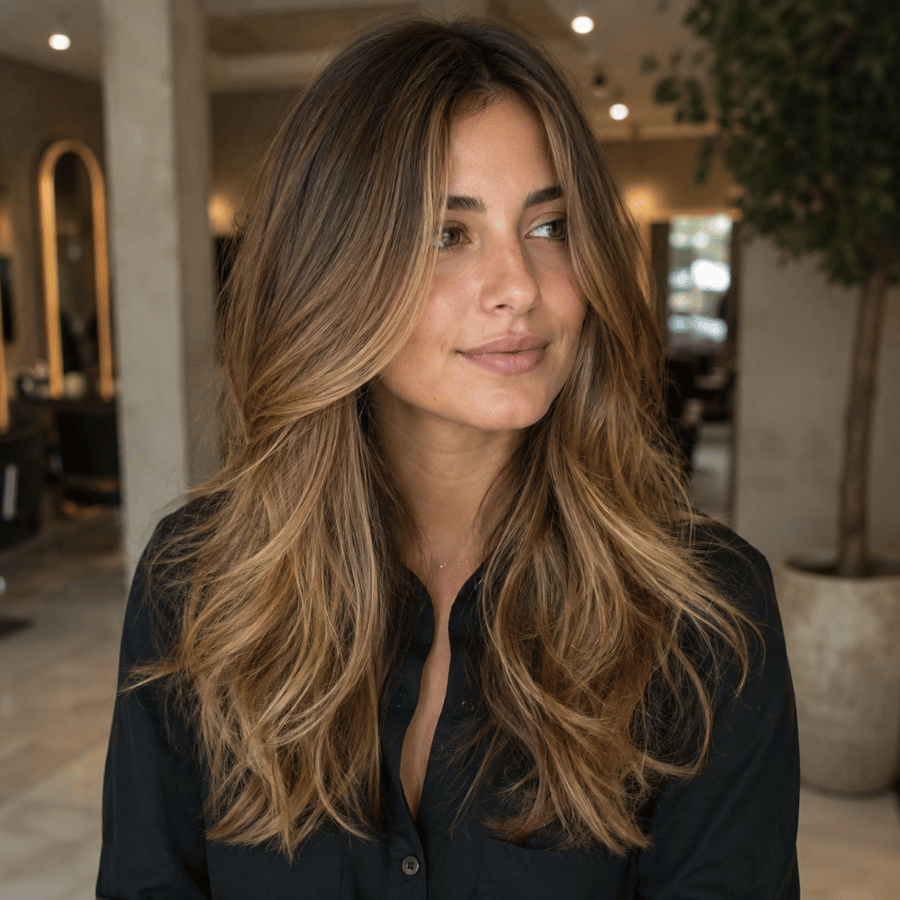
This is the sweet spot. Medium brown is close enough to caramel territory that the lift is moderate, the tonal result is predictable, and the grow-out is graceful almost by default.
 See also14 Things to Know Before You Color Your Hair
A level 5–6 base gives colorists room to work with real dimension — deeper at the root, brighter golden-caramel through the mids and ends. The natural depth acts as a built-in shadow root. This is the version that actually earns the “low-maintenance” label.
A gloss treatment every 6–8 weeks keeps the warmth clean. The grow-out stays soft because the contrast between base and caramel isn’t dramatic enough to create a hard line.
On Light Brown or Dark Blonde Hair (Level 7–8)
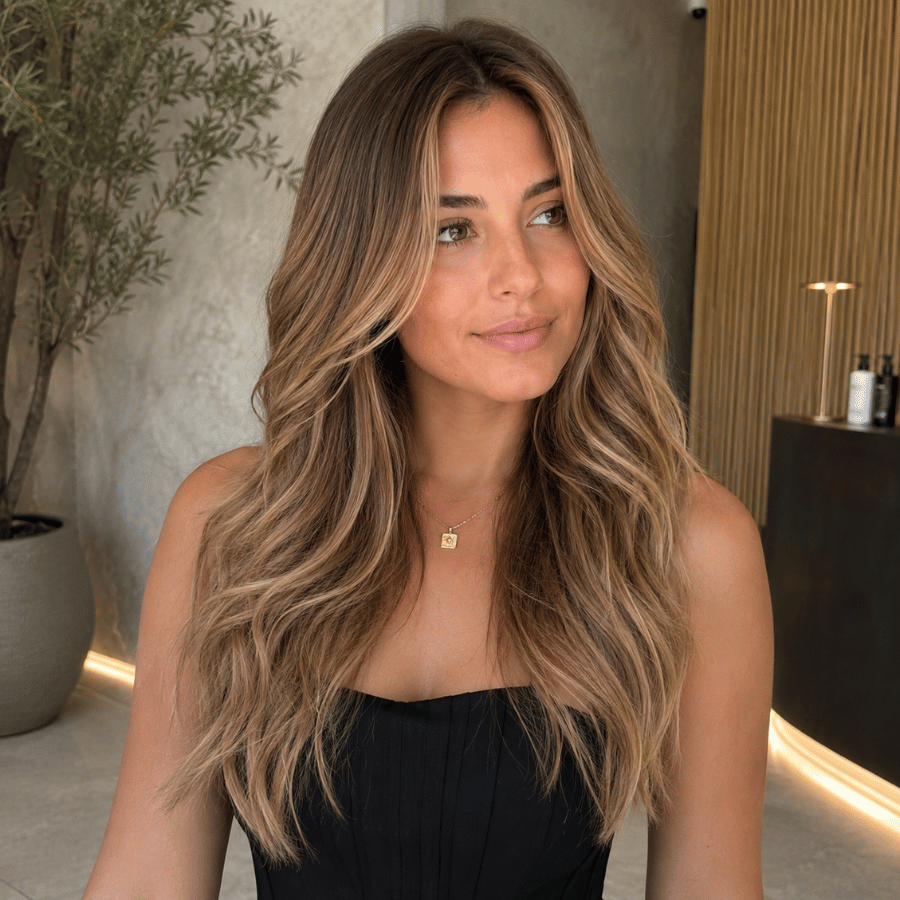
If you’re already in the dark blonde range, you may need less than you think. Sometimes a toner or gloss is all that’s needed to shift your existing blonde warmer and richer.
The risk here is different: instead of under-lifting, the concern is over-lifting and losing the richness that defines caramel. Over-processed caramel just looks like faded blonde. If you’ve been getting progressively lighter highlights, adding caramel lowlights back in is often the right recalibration — it brings back the visual weight that gives caramel its identity.
On Blonde Hair — Adding Depth, Not Lift
This surprises people. If you’re already quite blonde and want caramel, the process is often about adding color, not removing it.
Reverse balayage — painting depth back into the root and midlengths — creates the contrast that makes caramel tones visible. Without that depth, caramel toner on light blonde just reads as a slightly warmer blonde. Pleasant, but not caramel.
Placement Decisions That Change Everything
The shade matters. Where and how it’s applied often matters more.
Two clients with the same formula can leave looking completely different depending on whether their colorist used balayage, foils, or a combination — and where those highlights are actually placed.
Balayage
The default for most caramel requests, and usually the right call. Hand-painted placement means soft transitions, no harsh lines, and grows out gracefully. Concentration is typically heavier around the face and through the ends, with the root area left deeper. Our complete balayage guide covers technique and real grow-out timelines.
Foil Highlights
Better for fine hair. Balayage’s diffused softness can read as washed-out when there’s not much hair to work with. Foils — placed in thinner sections, closer to the root — create more defined contrast, which gives the illusion of thickness and movement.
Lowlights
Underused and underrated. Painting darker caramel or warm brown lowlights back into an existing blonde creates the shadow and contrast that makes the whole look work. Essential if you’ve gone too light and want to come back to something dimensional without looking muddy.
Root Shadow
The single most important placement decision for grow-out longevity. A demi-permanent shadow root — painted 1–2 inches from the scalp — means the grow-out line stays soft for months instead of weeks. Ask about it if your colorist doesn’t mention it. It’s the difference between a 6-week touch-up cycle and a 12-week one.
Face-Framing Pieces
A half-shade lighter around the face is one of the fastest ways to make caramel look fresh. But overdone — too blonde, too thick, too disconnected — it becomes the chunky “money piece” effect that’s already aging out. The refined version is subtle: blended into the hairline, not sitting on top of it.
Asking for caramel blonde “all over” often creates the flattest version of the shade. What makes caramel blonde feel expensive is usually the dimension.
Slightly deeper roots, softer brightness around the face, and lighter ribbons through the ends create movement that still reads natural in real life.
That dimensional finish is everywhere right now. It just isn’t single-process color. There’s a difference.
How Hair Texture Changes Caramel Blonde
Color behaves differently on different hair, and caramel is no exception. The same formula and placement can produce soft sun-warmed ribbons on one person and muddy streaks on another — not because the color was wrong, but because the technique didn’t account for how texture interacts with light.
Fine Hair
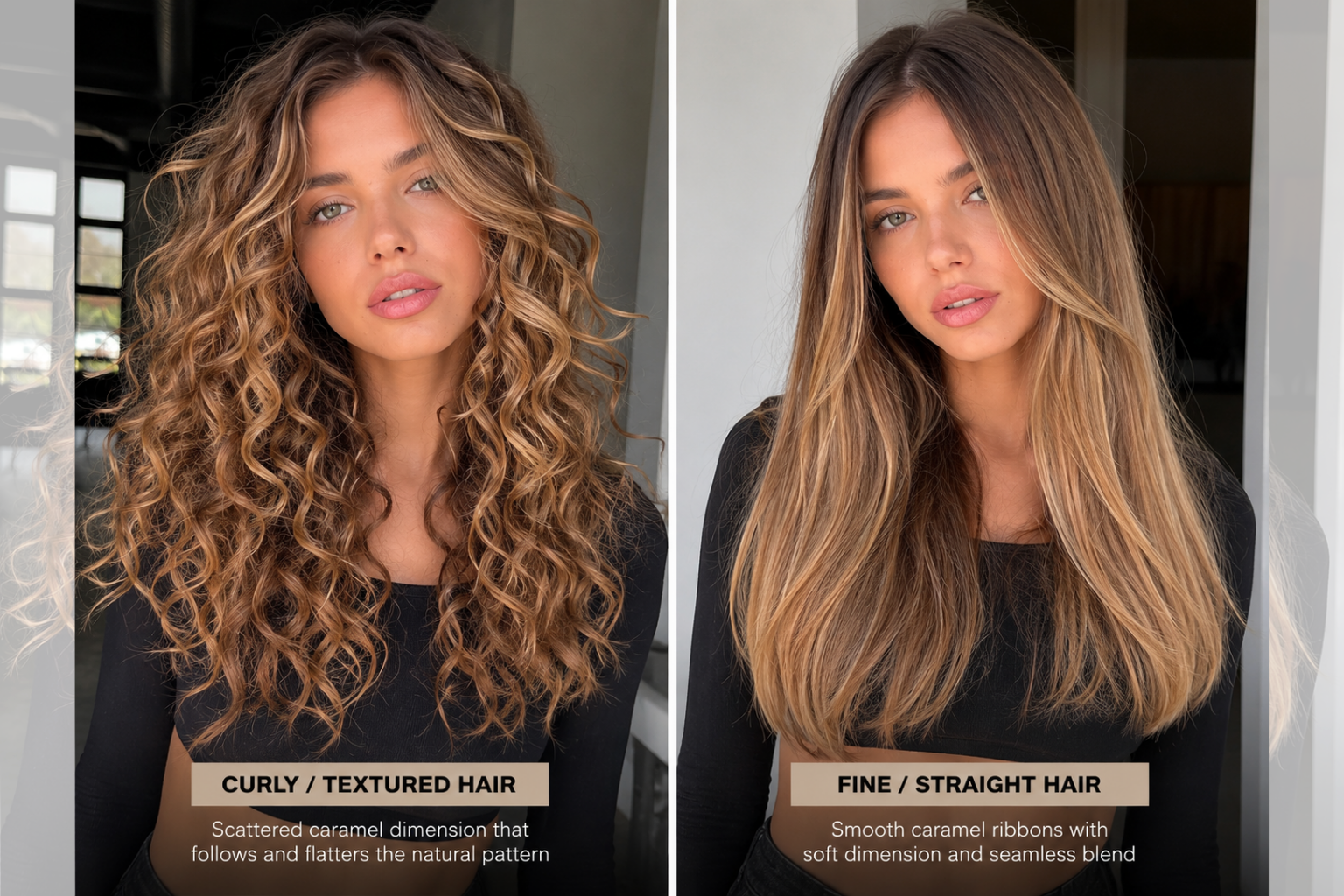
Fine hair reflects light aggressively. Each strand is thinner, so highlights appear more prominent — great for brightness, risky for dimension. Over-lightened fine hair loses the depth that gives caramel its character.
The fix is restraint: finer foils, slightly deeper caramel tones, fewer highlights overall. The result should feel like light passing through the hair, not bouncing off one flat surface.
Fine hair is also typically more porous, which means it absorbs toner faster and fades quicker. Plan for gloss refreshes every 4–6 weeks rather than 6–8.
Thick or Coarse Hair
Dense hair has the opposite problem: it swallows caramel tones. What looks vibrant on a strand test can disappear into the mass of hair when it dries.
Placement needs to be bolder — wider sections, slightly higher contrast, more brightness where it’s most visible. Subtle babylights that look stunning on fine hair will vanish on thick, coarse hair. Your colorist should adjust technique, not just formula.
Curly and Wavy Hair
Curls change how color reads entirely. A highlight that looks like a smooth ribbon on straight hair becomes a scattered pattern on curls — each one catching and reflecting light at a different angle. This is actually an advantage. Curls create natural dimension that straight hair has to work harder to achieve.
But placement on curly hair requires a colorist who understands curl patterns. Painting on stretched, straightened hair often produces results that disappear when the curl springs back. The best caramel results on curly hair come from working in the natural curl state. Our curly hair balayage guide covers placement specifics in depth.
Dry curly hair with highlights doesn’t look sun-kissed — it looks fried. Commit to a regular hydrating mask routine after any lightening service. It’s not optional.
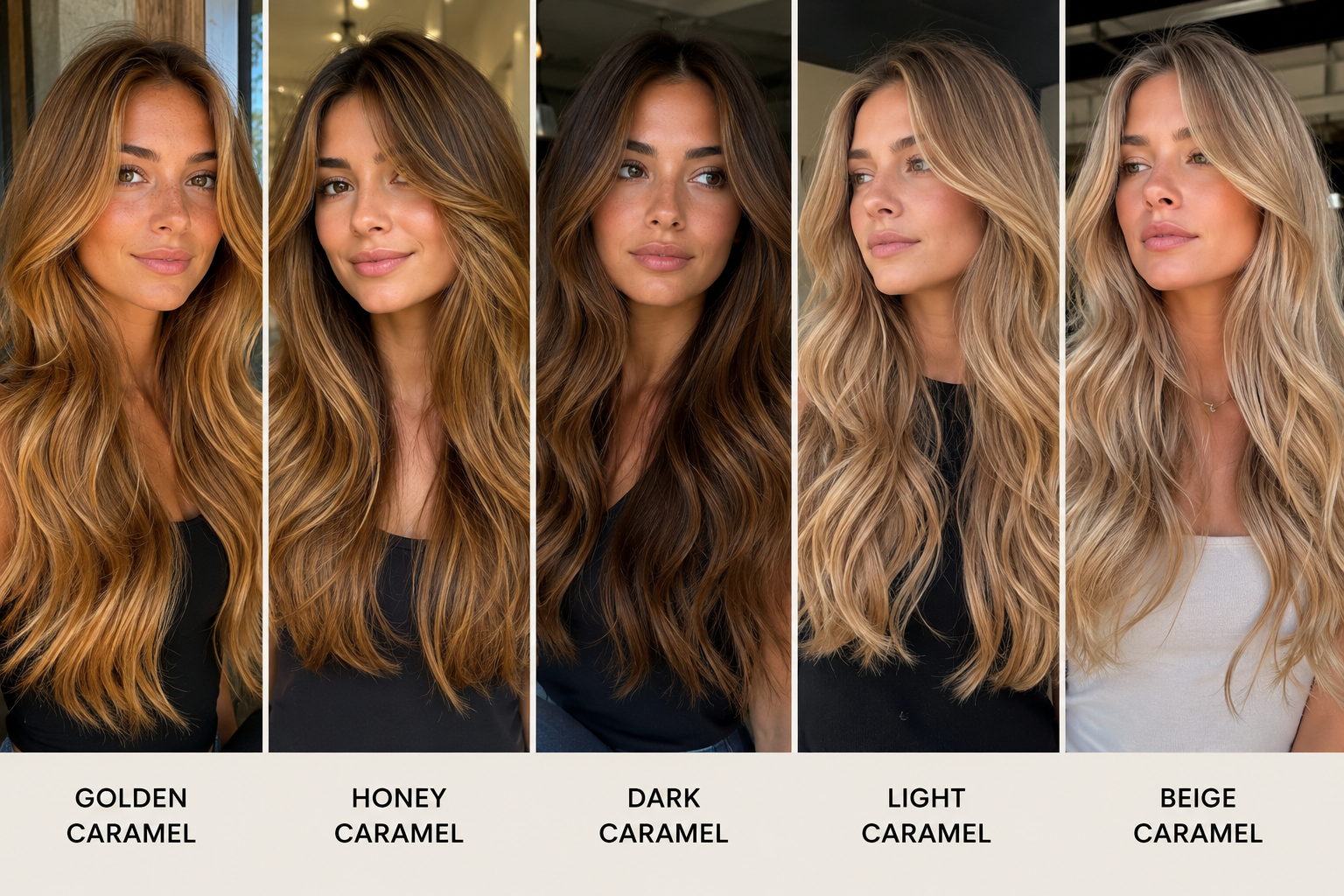
Shades Within the Shade: Your Caramel Blonde Options
Not every caramel is interchangeable. The variation you choose shifts the mood, the maintenance, and how the color interacts with your skin. If you’re torn between blonde and brunette, bronde hair color is the middle ground.
Golden Caramel Blonde
Warmest / Most saturated
Strong yellow-gold undertones that catch light aggressively. Photographs beautifully in warm natural light. Requires the most maintenance — that bold golden base is the first thing to shift toward brassiness as toner fades.
Honey Caramel Blonde
Softest / Most versatile
Blends beige, gold, and a touch of amber without committing hard to any one direction. Wears well year-round. This is often the shade people picture when they say “caramel blonde” — they just don’t know the name.
Dark Caramel Blonde
Closest to bronde / Lowest maintenance
Level 6 with golden-warm ribbons, significant depth retained. Grow-out is nearly invisible because the contrast between highlight and base is minimal. Looks darker indoors than it actually is — don’t judge it by overhead lighting.
Light Caramel Blonde
Most blonde / Highest maintenance
Bright, sunlit, leans more blonde than brown. Beautiful but demanding — requires more lift, fades faster, and can look washed-out without regular gloss work. Not a “color it and forget it” shade.
Beige Caramel Blonde
Coolest adjacent / Most sophisticated
Muted, more restrained, reads as refined rather than sunny. Safer for cool-undertone skin. If you’re unsure which direction to go — start here. It’s easier to push warmer later than to pull back from too much gold.
Caramel Blonde with Lowlights
Technique variation / Adds longevity
Darker pieces woven through the caramel create the illusion of movement and depth, even on flat, straight hair. Extends color life — the eye reads dimension even as the lighter caramel fades slightly. A smart choice for anyone who goes 3+ months between appointments.
If you find yourself drawn to the copper end of the spectrum and wondering whether caramel is warm enough — you might actually be after copper balayage. It’s the next step up in saturation from golden caramel.
Is Caramel Blonde Having a Moment?
Yes — and it’s not an accident. The move away from icy, heavily toned blondes has been building for a while. Warm, dimensional, “expensive brunette” color is where editorial hair is landing right now. Caramel sits at the center of that shift.
What’s specifically trending within the caramel family: rooted placements, glossy dark caramel (the bronde-adjacent version), and lived-in caramel balayage that looks like sunlight and summer rather than a salon visit. Less contrast, more movement, more warmth. The anti-icy era is real — and caramel blonde is its most wearable expression.
Maintenance: What It Actually Takes
Most caramel blonde content tells you to use color-safe shampoo and book regular appointments. True, but not useful. Here’s the specific information that actually helps you plan.
The Fade Timeline
The honeymoon. Toner is fresh, warmth is controlled, depth is intact. Your caramel looks exactly like it did leaving the salon. Enjoy it.
The toner starts softening. Golden caramels lean slightly more yellow. Beige caramels lose their cool edge.
This is normal, not failure. A gloss refresh here resets the tone without a full color appointment.
Without a gloss, the caramel has faded into a warmer, lighter version of itself. Fine or porous hair fades faster.
Some people prefer this lived-in stage, but it’s no longer the polished caramel you started with.
Full grow-out territory. Root line is visible, caramel has softened significantly, ends may be noticeably lighter.
 See also30 Copper Balayage Hair Color Ideas That Bring Serious Heat
This is when “why does my caramel look brassy” searches spike. It’s because the toner is gone, not because your colorist did anything wrong.
Understanding the difference between a gloss and a glaze matters here — they do different things, and knowing which your maintenance plan needs prevents wasted appointments.
Brassiness vs. Flatness — Two Different Problems
Brassiness (orange-gold shift) happens when toner washes out and underlying warm pigment from the lightening process is exposed. Accelerated by hard water, sun exposure, and sulfate-heavy shampoo. Purple shampoo helps — but it doesn’t fix the root cause.
Flatness (caramel loses richness, looks like faded blonde) happens when tonal depth washes out without being replaced. Purple shampoo makes this worse, not better. The fix is a color-depositing mask or gloss that adds warmth and depth back in simultaneously.
Home Care Non-Negotiables
- Sulfate-free shampoo. Sulfates strip toner faster than almost anything else you do between appointments. If it foams aggressively, it’s too stripping. Our best shampoos for balayage roundup applies directly to caramel maintenance.
- Heat protection, every time. Not most of the time. Heat opens the cuticle and accelerates fade. Daily hot tools mean noticeably faster color loss.
- UV protection. Sun exposure oxidizes warm tones, pushing caramel toward a washed-out version of itself. A UV-protective leave-in isn’t a luxury — it’s maintenance.
- Cool-to-lukewarm rinse water. Hot water opens the cuticle. Nobody loves a cold rinse. It makes a measurable difference anyway.
- Wash frequency matters. Overwashing is one of the fastest ways to strip tone. Most people with color can safely extend their wash schedule.
Grow-Out Reality — Planning for Month 3 and Beyond
Grow-out should be part of the conversation at your first appointment. Not an afterthought six weeks later.
The biggest factor in graceful grow-out is root placement. Color applied right up to the scalp with no shadow transition creates a visible stripe at week 6. A soft root melt — even just 1–2 inches — turns that stripe into a gradient that holds for months without looking neglected.
Asking for “brightness right up to the root” feels right in the salon chair. By month three, you’ll understand why your colorist probably hesitated.
Balayage grows out better than foil highlights by design — the lightened sections are already concentrated away from the scalp. But even balayage benefits from a root melt rather than an abrupt color start.
Tell your colorist upfront if you go 4+ months between appointments. It changes where they concentrate brightness, how much contrast they build in, and whether they recommend a gloss-only appointment between full color sessions.
“The polished caramel on Instagram is a photo from appointment day.”
Week 10 looks different. Softer, warmer, more lived-in. If you’re comparing your 8-week-old color to someone’s fresh salon photo, you’re not comparing real things.
That’s not fading. That’s just how color works.
What Looks Expensive vs. What Doesn’t
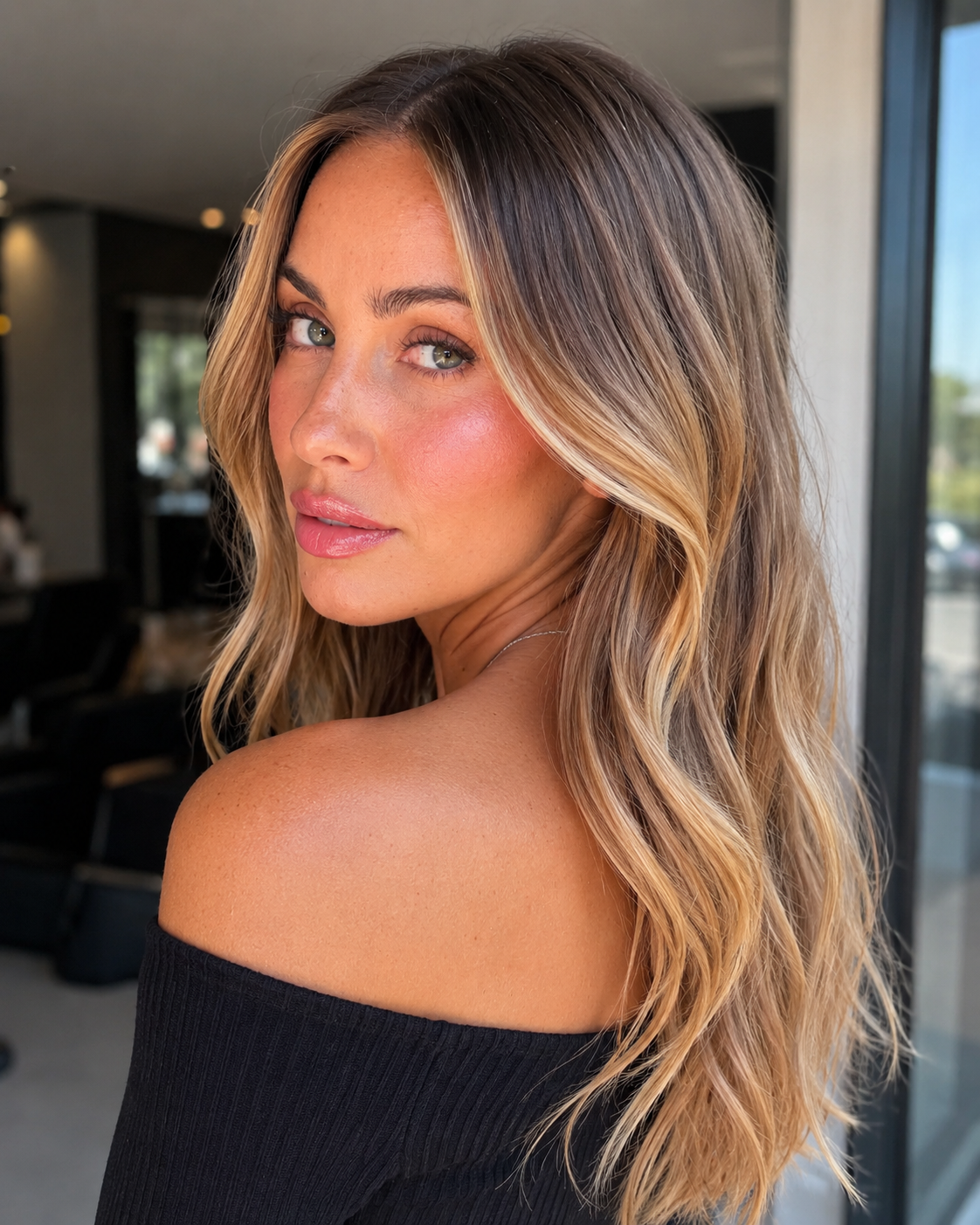
The shade can be identical. The difference between salon-quality caramel and an obvious dye job is almost always in the details — not the formula.
Expensive Caramel Has Dimension
Multiple tones: slightly deeper at the root, true caramel through the body, a touch of brighter warmth at the ends and around the face. The eye moves through the hair and finds variation. Mimics how sun exposure actually works — lighter at the outer layers, deeper underneath, brightest where light hits most.
Cheap Caramel Is Flat
One shade, root to end — even a beautiful shade. Natural hair is never one tone. Single-process caramel, however well-formulated, always reads artificial. This is the ceiling of box dye: it deposits evenly. A colorist builds a palette.
Tone Matching
When caramel is too golden for someone’s complexion, it looks separate from them — like an accessory. Well-matched caramel looks organic. This is the undertone conversation your colorist should be having before mixing anything.
Overtoning Is a Real Problem
Heavy-handed toner that looks painted-on or candy-colored ages the result immediately. The best caramel toning is semi-transparent — letting the lightened hair show through. If it looks opaque and solid, it was toned too heavily.
Contrast Control
Wide, high-contrast pieces that jump from dark brown to light caramel in an inch are mid-2000s highlights. The transition should be gradual — watercolor, not stripes.
How to Talk to Your Colorist About Caramel Blonde
You’ve seen the pictures. Now you need to communicate what you want to a real person who’s about to mix chemicals. This conversation matters more than the formula.
Bring three reference photos, not one. One photo becomes a single target — any deviation feels like failure. Three photos show your colorist the range you’re drawn to, and they can identify the common thread: more depth? more brightness? more warmth? That pattern tells them more than any single image.
Be honest about maintenance tolerance. If you’re not coming back every six weeks, say so upfront. Your colorist can design a color that looks intentional at week 12 — but only if they know that’s what you need going in.
Disclose your hair history. Previous color — especially box dye, henna, or any red or dark tones in the last year — changes the process. Metallic salts interact unpredictably with lightener. A strand test before the full appointment is worth the extra time. More on what to know before coloring your hair.
Ask about the process, not just the result. How many sessions? What type of lightener? Will there be a root shadow? These aren’t annoying questions. Most colorists prefer them to the alternative: nodding through a consultation and then being surprised by the outcome.
Say what you don’t want. “I don’t want it to look orange” or “I don’t want a harsh root line” sets boundaries that are just as useful as aspirational references.
Your Pre-Appointment Checklist
The best caramel blonde appointments usually start with clearer expectations, not more inspiration photos.
What is my natural color level right now?
Have I colored my hair in the last 12 months, and with what product?
How often am I realistically willing to come in for maintenance?
Do I heat-style daily?
Am I open to a root shadow, or do I want brightness right to the scalp?
What’s my comfort level for a first session, subtle or dramatic change?
Frequently Asked Questions
Is caramel blonde the same as honey blonde?
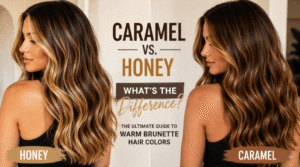
No. Honey blonde is lighter, more yellow-gold, and sits higher on the brightness spectrum. Caramel blonde is deeper, richer, and has more brown warmth in it. On a darker starting base, the difference becomes very visible — honey blonde requires significantly more lift.
Can caramel blonde work on very dark hair?
It can — but expect a multi-session process and higher maintenance than you’d see on a medium-brown base. The most realistic approach for level 2–4 hair is caramel highlights or caramel balayage against your natural depth rather than an all-over lift. The contrast looks intentional, protects the hair, and grows out more gracefully.
How long does caramel blonde last before fading?
Toner holds strongest for 3–4 weeks, then softens over the following 4–6 weeks. By week 10–12, most caramels have faded into a lighter, warmer version of themselves. A gloss refresh every 6–8 weeks extends the polished look. The balayage or highlight placement itself is permanent until cut off.
Is caramel blonde high maintenance?
It depends on your starting point. From a medium-brown base with balayage placement, it’s genuinely one of the lower-maintenance warm blonde options. From a very dark base with all-over brightness, it’s moderate to high. In both cases, home care — sulfate-free shampoo, heat protection, occasional gloss — extends the life significantly.
What’s the difference between caramel blonde highlights and caramel balayage?
Highlights use foils for more defined, often more uniform lightened sections. Balayage is hand-painted freehand, creating softer transitions that grow out more seamlessly. Many colorists use a combination of both for the best result — foils near the face for precision, balayage through the lengths for movement.
Will caramel blonde make my hair look brassy?
Not if the initial toning is right and you maintain it. Brassiness comes from underlying warm pigment being exposed as toner fades — it’s not inherent to the shade. When the warmth starts feeling orange or yellow rather than golden, a gloss or toner refresh is needed. That’s not a color failure; it’s a normal maintenance moment.
How much does caramel blonde cost at a salon?
In Austin, a full balayage with toner typically ranges $200–$450+ depending on hair length and density. A gloss-only maintenance appointment is considerably less — usually $75–$150. First-time color on dark hair requiring multiple sessions will be at the higher end. Any reputable colorist will give you a quote during the consultation before starting.
Can I do caramel blonde at home?
You can apply a caramel box dye, but you won’t achieve the multi-tonal, dimensional result that defines salon caramel blonde — box dye deposits one shade evenly. For maintenance between salon visits, a color-depositing mask or at-home gloss is a safer option than attempting highlights yourself.
Caramel blonde has staying power because it solves a real problem: warmth without brassiness, dimension without high contrast, a color that looks considered at week one and still presentable at week twelve. When the
shade, placement, and maintenance plan are matched to the person wearing it — it stops being “a color” and starts being your color.
Ready to find yours? Schedule a color consultation at Salon 1150 — we’ll figure out the shade, placement, and plan before anything touches your hair.