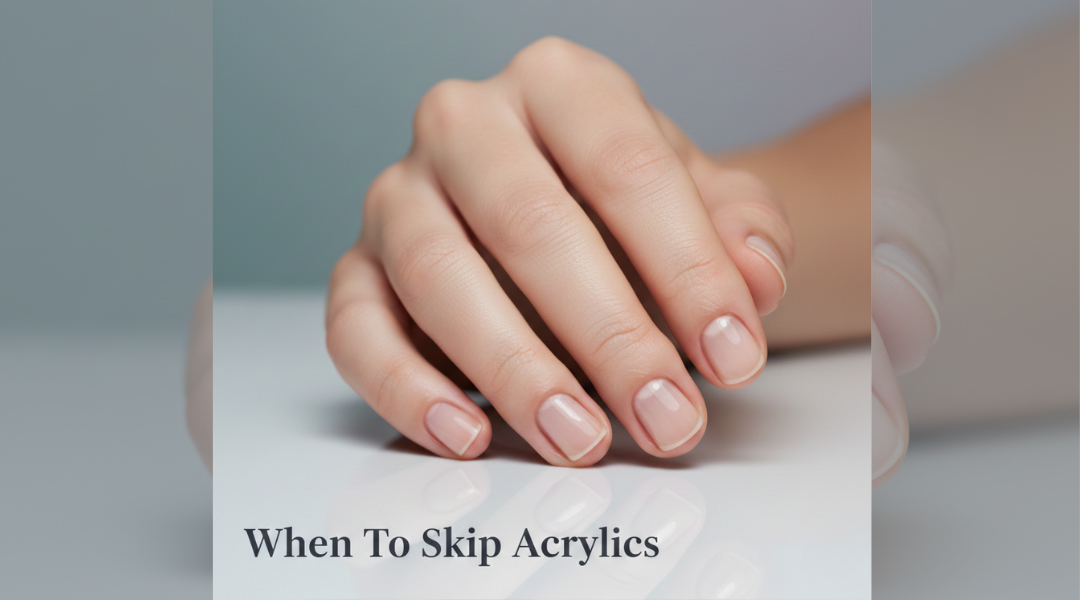
If you are wondering when should you not get acrylic nails, this guide is for you. At Salon 1150 we specialize in teaching clients how to make safe choices for long-term nail health. Saying no is sometimes the best service. Read the clear signs, the recovery timelines, and the practical alternatives a professional will recommend.
What acrylic nails are and why compatibility matters
Acrylic nails are a hard overlay formed from liquid monomer and polymer powder. They create length and durability but need a stable natural nail for adhesion. When the natural nail is compromised, acrylics do not protect. They add stress. Our stylists are trained to evaluate structural compatibility before a single product touches your nail plate.
Why nail pros sometimes refuse acrylics without apology
When techs refuse, it is about safety and liability, not judgment. Professionals refuse to prevent infections, prevent permanent damage, and protect other clients. A refusal reflects experience-based pattern recognition: certain visual signs reliably predict predictable harm. If a tech refuses, ask for the reason and a specific recovery plan.
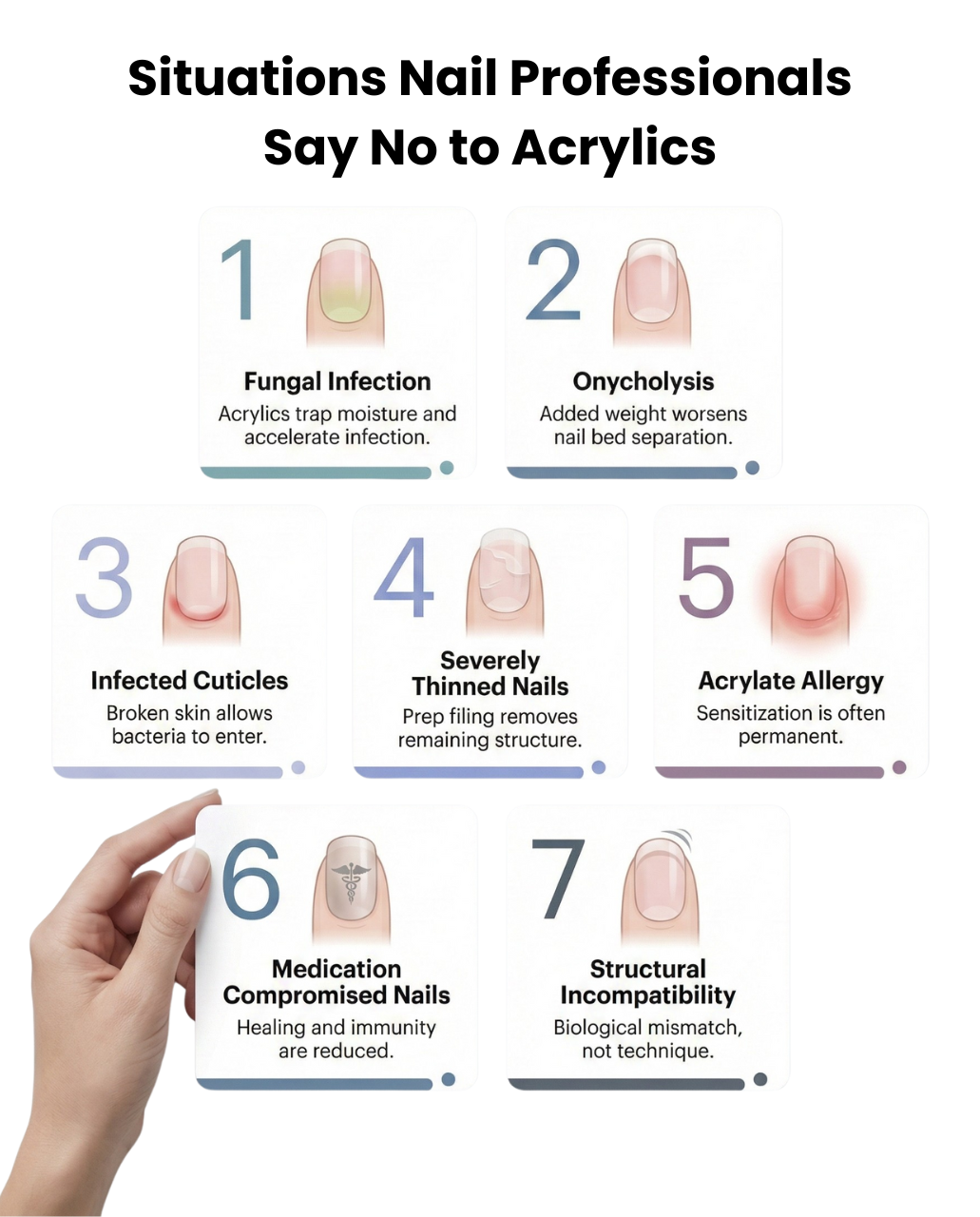
Seven real situations pros say “no” to acrylics
1. Visible fungal infection under the nail plate
Signs: yellow/green/brown discoloration, thickening, foul odor.
Why we refuse: Acrylics trap moisture and accelerate fungus spread. Treatment often takes 3–9 months. Immediate removal and dermatologist evaluation are required.
2. Onycholysis — nail bed separation
Signs: opaque white gap, loose nail, sometimes green tinge.
Why we refuse: Weight and adhesive worsen separation. Healing can take months. Apply no overlays while healing; keep nails short and dry.
3. Active cuticle infection or open wounds
Signs: redness, swelling, pus, bleeding.
Why we refuse: Broken skin is an entry point for pathogens. Filing and product application will worsen infection.
4. Severe thinning or chronic peeling of the nail plate
Signs: paper-thin nails, persistent splitting, repeated damage from prior sets.
Why we refuse: Prep filing removes remaining layers. Recovery requires 3–6 months without enhancements.
5. Confirmed acrylate allergy or contact dermatitis
Signs: blistering, redness, spread to eyelids or face after repeated exposure.
Why we refuse: Sensitization is often permanent. Cross-reactivity means gels and many adhesives are unsafe.
6. Clients on medications that compromise healing
Examples: isotretinoin, some chemotherapy agents, systemic immunosuppressants.
Why we refuse: These drugs thin the skin and slow recovery. We ask for medical clearance.
7. Structural mismatch — extreme curvature or chronic lifting
Signs: constant lifting within days, repeated failures across salons.
Why we refuse: Repeated fills damage the plate. This pattern signals biological incompatibility, not poor technique.
What refusal actually protects
Refusal prevents infection, permanent thinning, and allergic escalation. It protects your ability to wear any form of enhancement in the future. Our approach is education-first: explain the reason, outline a timeline, and offer safer options.
Practical alternatives and next steps
- Builder gel overlays for structural support without aggressive filing. (Wait 2–4 weeks post-removal for recovery if nails are mildly damaged.)
- Press-on nails for immediate aesthetics without chemicals or filing. Safe during recovery.
- Silk or fiberglass wrap when nails need reinforcement with minimal prep.
- Conservative gel polish for color only; not suitable if you have acrylate allergy.
- Nail restoration plan: weekly hydrating treatments, topical keratin treatments, stop all enhancements for 3 months for severe thinning.
Red flags and immediate actions
- If you see green under acrylics: remove enhancements and see a dermatologist.
- If you feel burning or blistering: stop all exposure and seek medical care.
- If your tech refuses: ask for a clear reason, a recovery timeline, and alternatives.
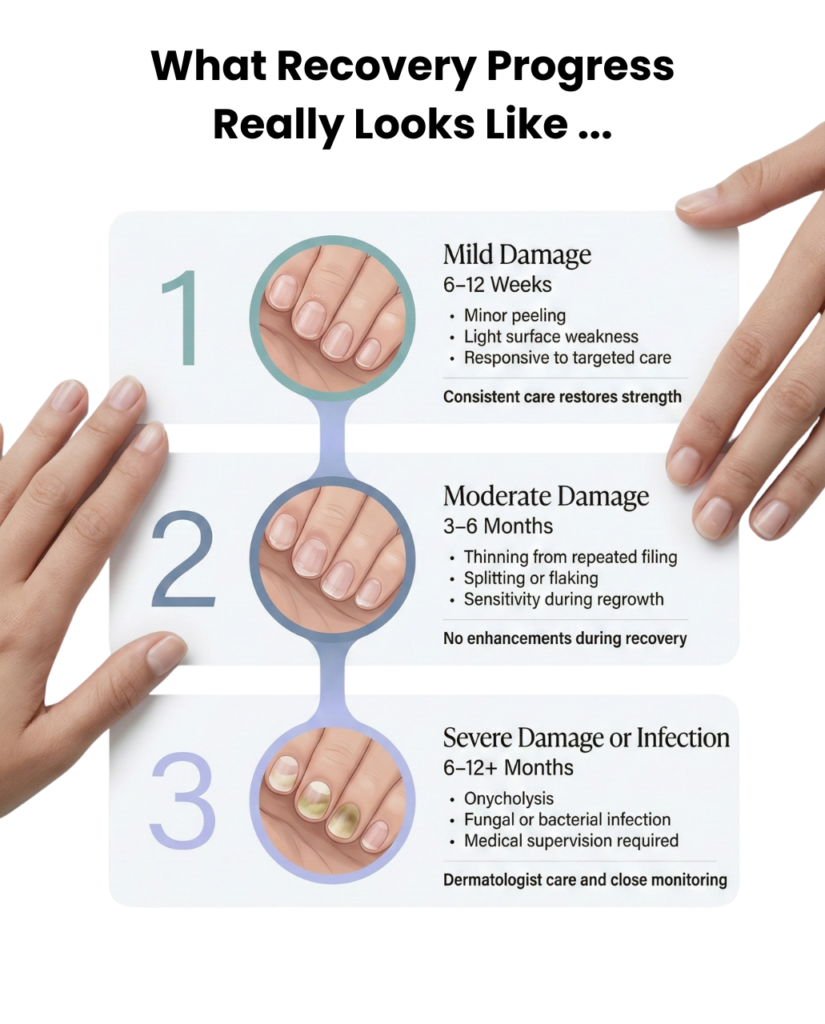
What recovery actually looks like
Mild damage: 6–12 weeks of targeted care.
Moderate damage (thinning, splitting): 3–6 months.
Severe onycholysis or infection: 6–12+ months with medical treatment and close monitoring. Recovery requires no enhancements during healing.
FAQs
How damaged is too damaged for acrylics?
If a nail peels in layers, lifts within days, or shows separation from the nail bed, acrylics should be avoided until recovery.
These signs mean the nail plate cannot support adhesion, so acrylics are more likely to worsen thinning, cause repeated lifting, or increase infection risk. Applying enhancements in this state usually extends damage instead of protecting growth.
For example, repeated early lifting across multiple sets often signals incompatibility rather than technique issues.
How long after a fungal infection can I try acrylics again?
Most people should wait at least 3–6 months after a fungal infection before considering acrylics.
Fungal issues resolve slowly, and acrylics create a sealed environment that increases the risk of recurrence even when the nail looks improved on the surface. Returning too early often leads to the infection coming back and spreading further.
In more severe or recurring cases, longer recovery time may be necessary to avoid relapse.
Why do acrylics always lift on me?
Chronic lifting usually means the nail surface, shape, or daily exposure to moisture prevents reliable adhesion.
Factors like curved nail plates, naturally oily nails, or frequent handwashing can cause acrylics to lift regardless of technician skill. Repeated refills often thin the nail further, making each set less stable than the last.
If lifting happens consistently across different salons, acrylics may simply not be compatible for you.
Can medications affect nail enhancements?
Yes, some medications can weaken nails or slow healing, making enhancements riskier.
Certain prescriptions affect skin and nail strength, which increases the chance of lifting, breakage, or prolonged recovery after removal. This is why disclosure matters before any enhancement service.
For example, clients on medications known to thin skin are often advised to pause acrylics until nail strength improves.
If a tech has refused you, it is protection, not punishment. Book a consult, and we will assess your nail health and map a safe plan.