Red hair color is not one look. It is a family of shades from soft copper to deep wine, and the right one depends on four choices: depth, undertone, application, and maintenance. Get them right and red looks intentional.
Think of red as a decision. Pick the shade family first, orange-red, brown-red, true red, or red-violet. Then set the depth and the application, all over or balayage. Finally, be honest about maintenance, because red fades faster than any other color family. This guide covers the eight shades, the costs, the words to use with your stylist, and the routine that keeps red looking like red.
The 8 Shades of Red Hair Color
Every red falls into one of four families: orange-reds are warm and bright, brown-reds are muted and natural, true reds are saturated and bold, and red-violets are deep and cool. The sections below explain each shade.
| Shade | Undertone | Best for | Starting color / lift |
|---|---|---|---|
| Copper | Warm, orange-gold | Warm fair to medium skin; green, hazel, or blue eyes | Level 6-8; light to medium brown, little lift |
| Auburn | Warm, reddish-brown | First-time redheads; warm, neutral, or olive skin | Level 4-6; brunettes, little or no lift |
| Cherry Red | Neutral to cool, true ruby | Cool or neutral undertones; medium to dark brunettes | Level 5-7; bright cherry needs lightening |
| Burgundy-Red | Cool, violet-red | Cool, olive, or deep skin; dark brunettes | Level 2-5; dark hair, no extensive lightening |
| Rose Gold | Warm-cool, pink-copper | Fair to light skin; blue, green, or hazel eyes | Level 8-10; blonde or pre-lightened hair |
| Wine | Cool, dark berry | Cool or olive skin; medium to deep hair | Level 2-4; medium to dark brown, little lift |
| Mahogany | Warm-neutral, brown-violet | Olive, medium, or deep skin; dark blonde to dark brown | Level 3-5; dark hair, little or no lift |
| Red Velvet | Cool, saturated crimson | Cool porcelain, neutral, or deep skin | Level 6-8; medium to dark brown, some lift for saturation |
Copper

Copper is warm, metallic orange-gold . It suits warm fair to medium skin, and green, hazel, and blue eyes. Light brown to dark blonde hair takes it with little lifting, around level 6 to 8, and caramel balayage softens it with golden-brown ribbons that break up the orange at the roots.
Auburn

Auburn is a warm reddish-brown, closer to chestnut and russet than to orange. It suits warm, neutral, and olive skin, and brown, hazel, and amber eyes. Brunettes at level 4 to 6 reach auburn with little or no lift, the best first red for anyone nervous about bleach. Auburn sits close to chocolate brown hair color, but it shows its red in sunlight.
Cherry Red

Cherry red is vivid, true ruby red with a neutral to cool base. It suits cool and neutral undertones, and dark brown, blue, and cool gray eyes. Medium to dark brunettes at level 5 to 7 are the easiest starting point. Bright cherry needs lightening, while black-cherry works on black hair without bleach.
Burgundy-Red

Burgundy-red is a deep, cool violet-red. It suits cool, olive, and deep skin, and dark brown, hazel, and blue-gray eyes. Dark brunettes at level 2 to 5 reach burgundy with no extensive lightening. The violet base in burgundy hair color keeps it cool, and it is why burgundy fades toward plum rather than orange.
Rose Gold
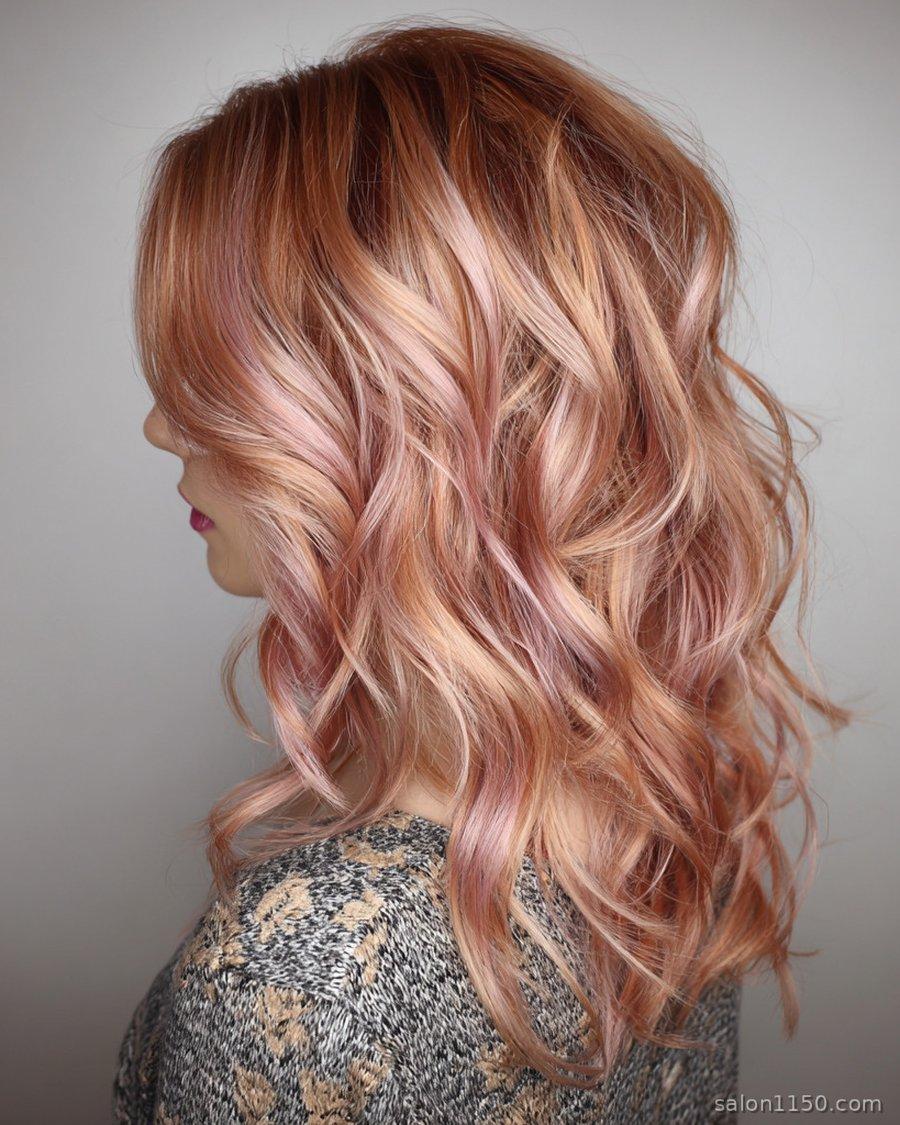
Rose gold is a soft, pastel metallic blend of copper, pink, and apricot. It suits fair to light skin, and light blue, soft green, or hazel eyes. It needs a light base, level 8 to 10, so blonde or pre-lightened hair is the usual starting point.
Wine

Wine, sometimes called mulled wine, is a rich dark berry red with a violet base, darker and cooler than burgundy. It suits cool olive, deep espresso, and neutral fair skin, and dark brown, black, and deep green eyes. Medium to dark brown hair at level 2 to 4 reaches wine with little lift. Light hair needs enough depth, or wine can look washed out.
Mahogany

Mahogany is a balanced reddish-brown with a brown-violet base. It suits warm golden, neutral olive, and medium to deep skin, and brown, hazel, and dark brown eyes. Dark blonde to dark brown hair at level 3 to 5 reaches mahogany with little or no lift. Light hair needs a darker, more saturated formula to hold the color.
Red Velvet

Red velvet is a saturated crimson, cooler and more intense than auburn but softer than bright cherry. It suits cool porcelain, neutral, and deep skin, and blue, green, and deep brown eyes. Medium to dark brown hair at level 6 to 8 is the usual starting point, and a dark base may need some lift.
How to Choose the Best Red Hair Color for Your Skin Tone
Skin undertone matters more than skin depth. Two people with the same skin tone can need opposite reds. Undertone decides whether a red looks harmonious or clashes.
Test your undertone in daylight. Veins on the inside of your wrist that look greenish usually mean warm undertones, bluish veins usually mean cool undertones, and a mix means neutral.

Use the result as a starting point, not a rule. Warm undertones pair with copper, auburn, and mahogany. Cool undertones pair with cherry, burgundy-red, wine, and red velvet. Neutral undertones can wear most reds, so do not let any chart prescribe one red per complexion. If you love warm red but are not ready for full copper, bronde hair color gives you the same warmth with a softer brown base. If vivid red feels too warm, look at cool-toned alternatives such as mushroom brown hair first.
Red Hair Color for Brunettes, Blondes, and Dark Hair
Your starting color decides how much work red takes. Permanent color lifts hair one to two levels while depositing red, so deep reds are reachable on dark hair without bleach. Vivid reds need a light base to show their true tone.
| Starting color | Reds that work without bleach | What needs lift |
|---|---|---|
| Light brown (level 5-6) | Auburn, copper-brown, cherry | Rose gold, bright cherry, vivid copper |
| Medium brown (level 4-5) | Auburn, mahogany, dark cherry | Bright copper, cherry red, red velvet |
| Dark brown (level 3-4) | Deep auburn, burgundy, wine, cherry cola | Bright cherry, copper, rose gold |
| Black (level 1-2) | Deep burgundy, subtle red reflections, black-cherry | Any bright or vivid red |
Brunettes have the easiest path to red. Virgin brunette hair takes red well. Previously colored brunettes are more complicated, because old pigment changes how new red develops, so tell your stylist about every color you have had. Do not expect any red without lift on black hair.
Blondes face the opposite problem. Blonde and bleached hair lacks the underlying warm pigment that red needs to hold onto, so going from blonde to a darker red can turn out too bright, uneven, or patchy, and it fades fast. Hair.com guidance is clear: bleached blonde hair usually needs a filler, a warm base color applied first, before the red goes on.
Red Balayage vs All-Over Red Hair Color
Red balayage and all-over red are different commitments. Balayage paints red through selected sections of your natural base, so the roots stay dark and the grow-out is soft. All-over red covers every strand, so the color is uniform and vivid, and the roots show a hard line.
| Red balayage | All-over red | |
|---|---|---|
| Effect | Ribbons of red through a dark base, dimensional | Uniform, vivid red from roots to ends |
| Cost | $150-450+ for a full application | $70-250 for a single process |
| Maintenance | Gloss every 4-6 weeks; root work every 3-6 months | Root touch-ups every 4-6 weeks; gloss every 4-6 weeks |
| Grow-out | Soft, no hard root line | Visible root line within weeks |
| Best for | Subtle dimension, low maintenance, first-time red | Bold color, vivid shades, full gray coverage |
| Commitment | Lower long-term commitment | Higher long-term commitment |
| Gray coverage | Partial, blends gray rather than covering it | Full, with a permanent formula |
Choose by your goal. Natural reddish-brown points to an all-over auburn. Bright copper works either all over or as copper balayage. Subtle dimension and low maintenance point to red balayage with your natural root left alone. Balayage is not automatically damage-free or bleach-free, and its real advantage is the softer grow-out, not longer-lasting pigment.
There is also a combination worth knowing about: a dark auburn or mahogany base with bright copper balayage highlights painted through it. You get the depth of an all-over color and the brightness of balayage. Our balayage guide explains the placement that creates that softer grow-out. Red balayage still needs gentle aftercare, so a sulfate-free, color-safe shampoo matters from the first wash, and our best shampoos and conditioners for balayage lists formulas that protect color-treated hair.
How Much Does Red Hair Color Cost?
Red costs more to maintain than brown or black, and the honest budget includes the follow-up visits. Prices vary by location, salon, hair length and thickness, and starting color, so treat these ranges as planning figures.
| Salon service | Typical range (US, 2026) |
|---|---|
| All-over single process red | $70-250 |
| Root touch-up | $50-160 |
| Full red balayage | $150-450+ |
| Partial balayage | $100-225 |
| Gloss or toner refresh | $40-150 |
| Bleach or lightening before red | $100-250+ |
| Major color correction | $150-800+ |
| At-home option | Typical range (US, 2026) |
|---|---|
| Box dye | $5-16 |
| Semi-permanent or direct dye | $10-25 |
| Gloss kits and tinted conditioners | $15-35 |
Two costs surprise people. The first is correction, which can cost more than the original service. The second is the yearly total: a gloss every 4 to 6 weeks plus root touch-ups adds up to far more than the first visit.
How to Ask Your Stylist for Red Hair

The biggest mistake is saying “red” without specifying which red. Use three words every time: saturation, depth, and distribution. Saturation means soft, natural, or vivid; depth means light, medium, or deep; distribution means all over, balayage, face-framing, or dimensional highlights.
Bring 3 to 5 photos: the exact shade in daylight, the same shade indoors, a photo on similar hair, a lived-in look a few weeks after coloring, and one photo of a result you do not want. The lived-in photo matters most, because it shows what the color looks like after the first fade.
Disclose your full chemical history, even years old: box dye, henna, vivid dyes, bleach, highlights, and smoothing treatments. Henna and metallic box dyes change how new color develops. Before the appointment, preview the shade on your own photo so you walk in knowing whether the depth suits your skin tone. Do not ask for a specific formula from a photo.
Ask these ten questions at the consultation:
- Will I need pre-lightening or a filler first?
- How many appointments will the first session take?
- Which undertone suits me, warm, cool, or neutral?
- Will this formula cover my gray, or just blend it?
- How fast will it fade on my hair?
- How often will I need a gloss or a root touch-up?
- Which shampoo and mask should I use at home?
- What will a year of maintenance cost?
- What will removal involve if I change my mind?
- Can I go back to my natural color or blonde later?
How Long Does Red Hair Color Last?
Red fades faster than any other color family. The reason is physical: red pigment molecules are the largest of any oxidative color, so they sit near the cuticle and wash out more easily than smaller brown or black molecules.
The fade follows a pattern. Week one brings high vibrancy. Weeks two to three bring a clear loss of intensity, though the warmth stays. Weeks four to six bring noticeable fading, Permanent red lasts 4 to 8 weeks, demi-permanent 4 to 6 weeks, semi-permanent 2 to 6 weeks, and a gloss 2 to 6 weeks. Vivid cherry and crimson fade fastest, in 2 to 4 weeks.

Watch the direction of the fade. Vivid reds usually fade toward copper, orange, or pink. Burgundy and wine fade toward plum. If your red turns muddy orange or pale pink within days, your hair is probably porous or bleached. A hair porosity test before you commit tells you whether your shade is likely to fade in days or weeks.
How to Maintain Red Hair Color

Red maintenance is a routine, not a single product. Do not wash for 48 to 72 hours after coloring, so the cuticle can close and lock the pigment in. After that, wash 2 to 3 times a week at most; less is better for red. Use lukewarm or cool water, because hot water opens the cuticle and lets pigment escape.
Use a sulfate-free, color-safe shampoo, and skip clarifying or deep-cleansing shampoos, which strip red fast. Add a color-depositing mask matched to your red family once or twice a week: copper for auburn and copper, ruby for cherry and burgundy, pink for rose gold. Wella Professionals recommends its Color Fresh Mask range for at-home refreshes. Book a hair gloss treatment every 4 to 6 weeks to top up the tone.
Protect the color from the elements. UV light fades red, so use a UV leave-in spray and a hat in strong sun. Chlorine and salt water strip color too, so wet your hair with fresh water and apply leave-in conditioner before swimming, Use a heat protectant. Wash frequency matters more than shampoo brand, and our guide to how often to wash hair explains how to set a schedule that suits your scalp. One warning: never use purple shampoo on red hair. It neutralizes yellow tones in blonde hair, and on red it strips the warm tones you paid for.
Is Red Hair Color Damaging? Risks and Things to Know
Red itself is not what damages hair. The damage comes from lifting, the bleaching or lightening needed to reach a vivid red from dark hair. Going from blonde to auburn needs little or no lifting, while going from black to bright cherry or rose gold needs substantial lifting.
Expect staining. Red bleeds for the first 3 to 5 washes, marking towels, pillowcases, light clothing, and skin. Wear gloves and do not wear white right after coloring.
Removal is the part people underestimate. Red leaves a warm residual tone, orange or gold, that is stubborn to remove. Going back to a cool ash blonde or light brown needs pigment removal, lightening, and toning, often across multiple sessions. Deeper reds such as wine, burgundy, and cherry are more persistent than copper and auburn. Semi-permanent red will not wash fully back to your original blonde, so do a strand test first. Going back to cool ash brown from red takes multiple sessions, because the warm residual pigment has to be lifted or neutralized first.
Patch test before every use. The FDA advises a patch test before every hair color application, even if you have used the same product safely before. Do not color an irritated, sunburned, or damaged scalp.
| Think twice if you | Why it matters |
|---|---|
| Have severely damaged hair | Lifting will make it worse, and porous hair will not hold red evenly |
| Wash daily with hot water | Frequent hot washing is the fastest way to strip red |
| Swim regularly or spend long hours in strong sun | Chlorine, salt water, and UV all fade red quickly |
| Have a history of dye allergy or skin sensitivity | Patch test every time, and get medical advice before coloring |
| Want a low-maintenance color | Red needs glosses, masks, and wash discipline, or it fades within weeks |
| Change color often | Red is hard to remove, so frequent changes mean repeated corrections |
Frequently Asked Questions
Does red hair color cover gray hair?
Permanent red covers up to 100 percent of gray when the formula is built for it, (Wella Koleston Perfect). Demi-permanent color covers up to 70 percent, based on Wella’s Color Touch figures, so it blends gray. For resistant gray, colorists often mix about 50 percent natural base with 50 percent red, and vivid fashion red and natural gray-coverage red are not the same formula. For brunettes, hiding gray hair for brunettes covers the blending techniques that work alongside a red base.
Can you dye dark hair red without bleach?
Light brown hair takes auburn, copper-brown, and cherry. Medium brown takes auburn, mahogany, and dark cherry. Dark brown takes deep auburn, burgundy, wine, and cherry cola. Black hair takes deep burgundy, black-cherry, and subtle red reflections. Vivid reds are different: bright cherry, vivid copper, and rose gold need lightening.
Red balayage vs all-over, which is better?
Red balayage is better for subtle dimension, a soft grow-out, and lower maintenance, with root work every 3 to 6 months instead of every 4 to 6 weeks. All-over red is better for bold color, vivid shades, and full gray coverage. Balayage costs more at the first visit but less over time.
How fast does red hair fade?
Vivid cherry and crimson show noticeable fading in 2 to 4 weeks. Permanent red holds 4 to 8 weeks, demi-permanent 4 to 6 weeks, semi-permanent 2 to 6 weeks, and a gloss 2 to 6 weeks. Without maintenance, most reds look noticeably duller after 4 to 6 washes.
Can I go back to blonde after red?
It is possible, but it is one of the hardest corrections. Red leaves a warm residual tone that has to be removed or neutralized before blonde can work, and the process usually needs pigment removal, lightening, and toning across multiple sessions. Semi-permanent red will not wash fully back to your original blonde. Expect a major correction to cost $150 to $800 or more, and do a strand test first.
Is red hair color high maintenance?
Red needs a gloss every 4 to 6 weeks, a color-depositing mask once or twice a week, washing 2 to 3 times a week at most, and protection from sun, chlorine, and salt water. If that sounds like too much, choose a lower-commitment red: auburn, copper-brown, or red balayage with your natural root left alone.
Red rewards the person who chooses deliberately. Pick the shade family first, match it to your undertone, be honest about the maintenance, and bring photos of the lived-in result.