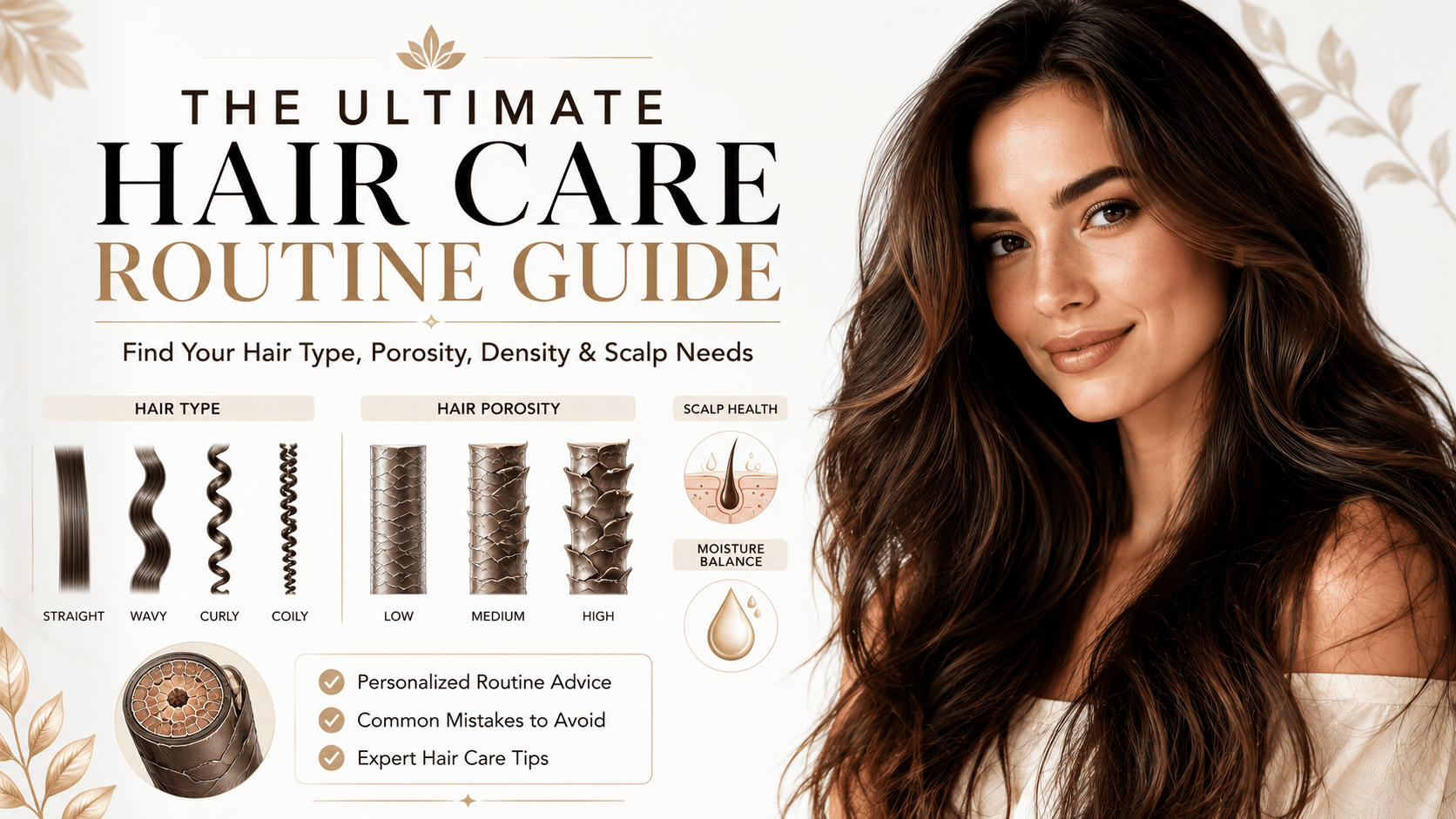
Most hair care advice focuses on hair type alone. In reality, your results depend on four things: hair type, porosity, density, and scalp condition.
This guide helps you identify each one and build a routine that actually matches your hair instead of following generic recommendations.
What a Good Hair Care Routine Actually Includes
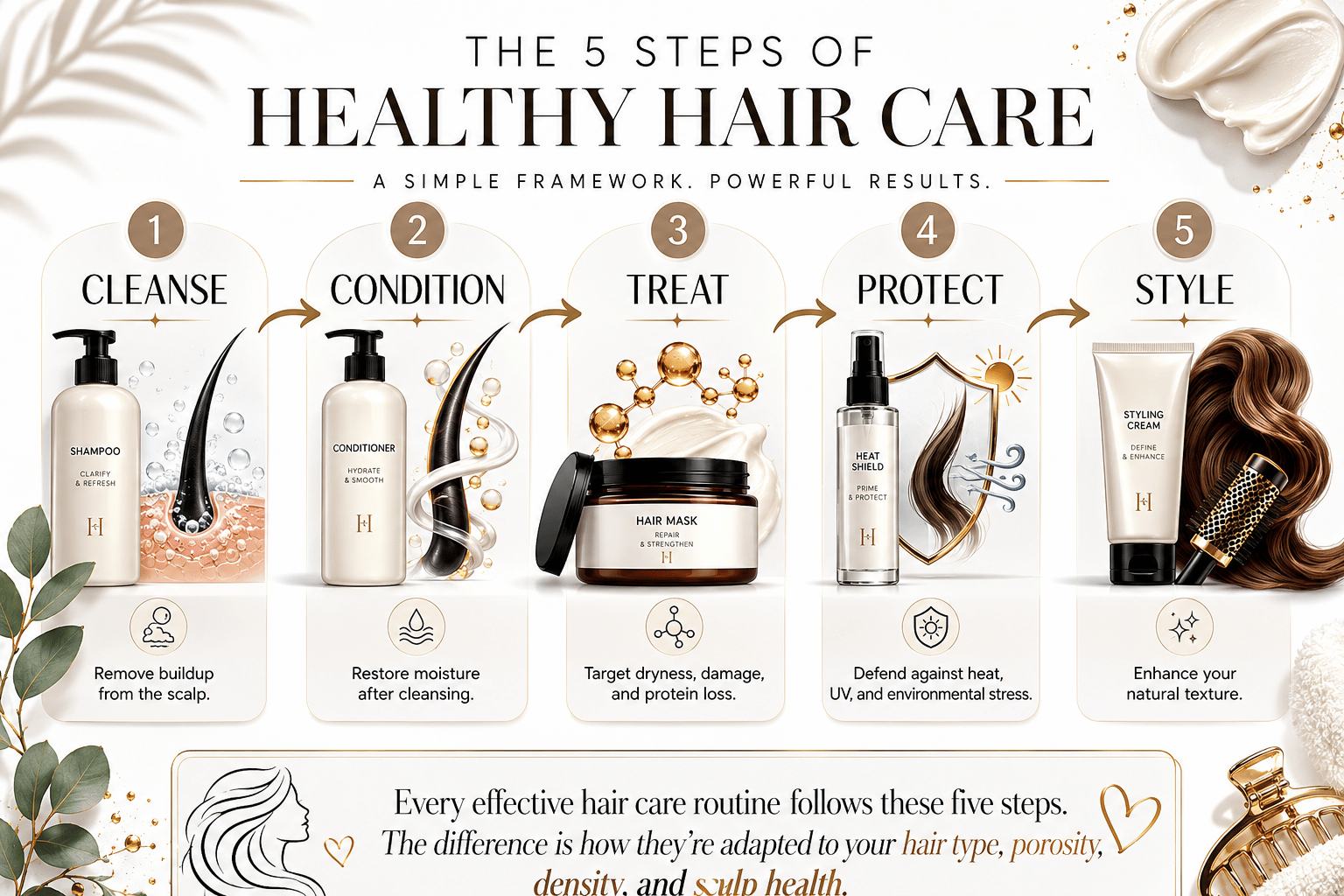
Every effective hair care routine comes down to five steps, in this order:
- Cleanse — Remove buildup from the scalp (not the lengths).
- Condition — Replace the moisture that cleansing strips.
- Treat — Address specific issues like damage, dryness, or protein loss with masks or targeted products.
- Protect — Shield hair from heat, UV, and environmental stress before it happens.
- Style — Apply styling products that work with your texture rather than fighting it.
That’s the skeleton. The specifics — how often, which products, how much — depend entirely on four things most guides collapse into one. Let’s separate them.
Step One: Diagnose Your Hair Before You Build a Routine
The biggest reason routines fail is that they’re built around hair type alone. Someone with Type 2 waves and low porosity needs a completely different approach than someone with Type 2 waves and high porosity — even though they’d get identical advice from most guides. Before choosing a single product, figure out where you land across four variables.
Hair Type: The Shape of Your Strand
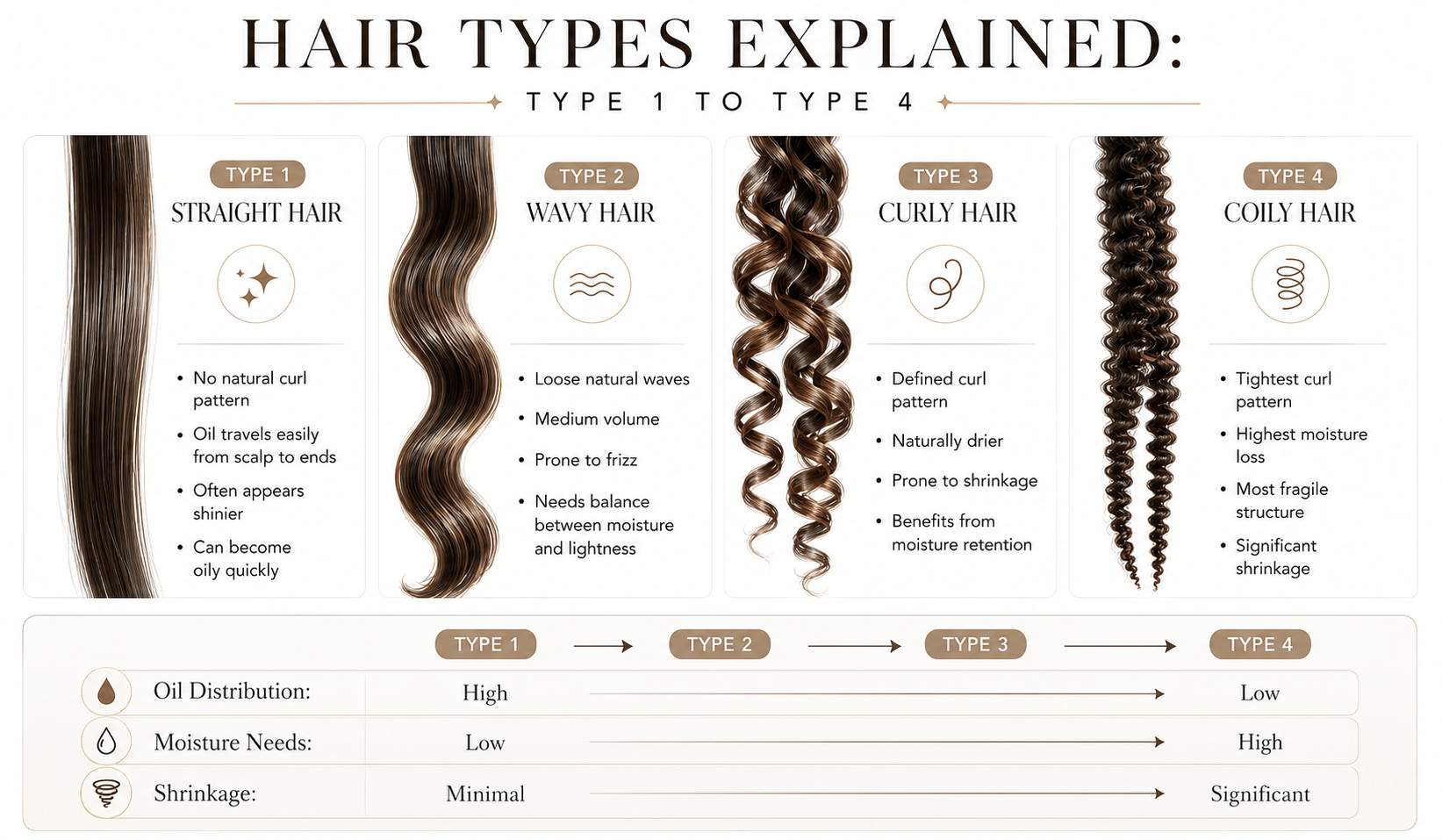
Hair type describes the natural pattern your hair forms when it’s clean, product-free, and allowed to air dry naturally. The André Walker system groups hair into four main categories.
Type 1
Straight HairHair lies flat against the head and reflects light easily, creating natural shine.
Type 2
Wavy HairFalls between straight and curly hair, ranging from subtle bends to well-defined waves.
Type 3
Curly HairDefined curls that spring back into shape. Natural oils struggle to travel through the twists of the strand.
Type 4
Coily HairThe tightest curl pattern with the highest tendency toward moisture loss and breakage.
Your Hair Type Is Only One Piece of the Puzzle
Hair type tells you the shape of your strands. It does not tell you how porous your hair is, how dense it is, how thick each strand is, or what your scalp is doing. Those factors often have a bigger impact on product choice and routine success than curl pattern alone.
Hair Porosity: How Your Hair Absorbs Moisture
Porosity describes how open or closed your hair cuticle is. It determines how quickly moisture enters the hair shaft, how long it stays there, and what types of products work best.
Low Porosity
Moisture struggles to get in
Medium Porosity
Balanced moisture retention
High Porosity
Moisture enters and escapes quickly
Quick Product Strategy
Use lightweight formulas. Avoid layering heavy oils and butters.
Most shampoos, conditioners, masks, and stylers work without adjustment.
Prioritize richer conditioners, creams, oils, and moisture-sealing products.
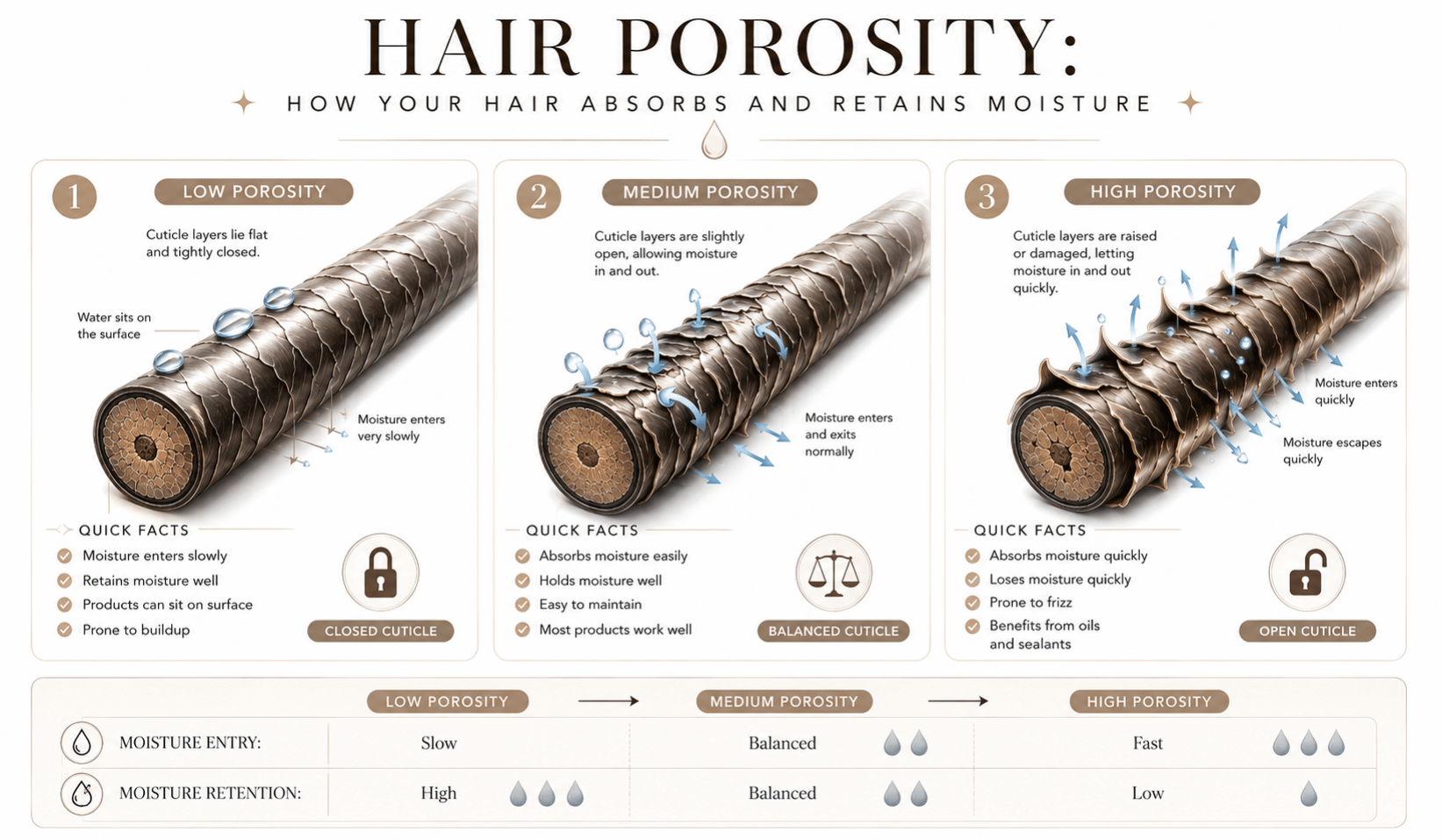
How to test it: The quickest clues come from how your hair behaves — how fast it gets wet in the shower, how long it takes to air-dry, and whether products absorb or just coat the surface. The float test you’ve seen online is a popular starting point, but it’s easily skewed by product residue, surface tension, and strand age, so treat it as a rough clue rather than a definitive answer. We wrote a full breakdown of the most reliable at-home porosity tests — including why most people have mixed porosity and what to do about it.
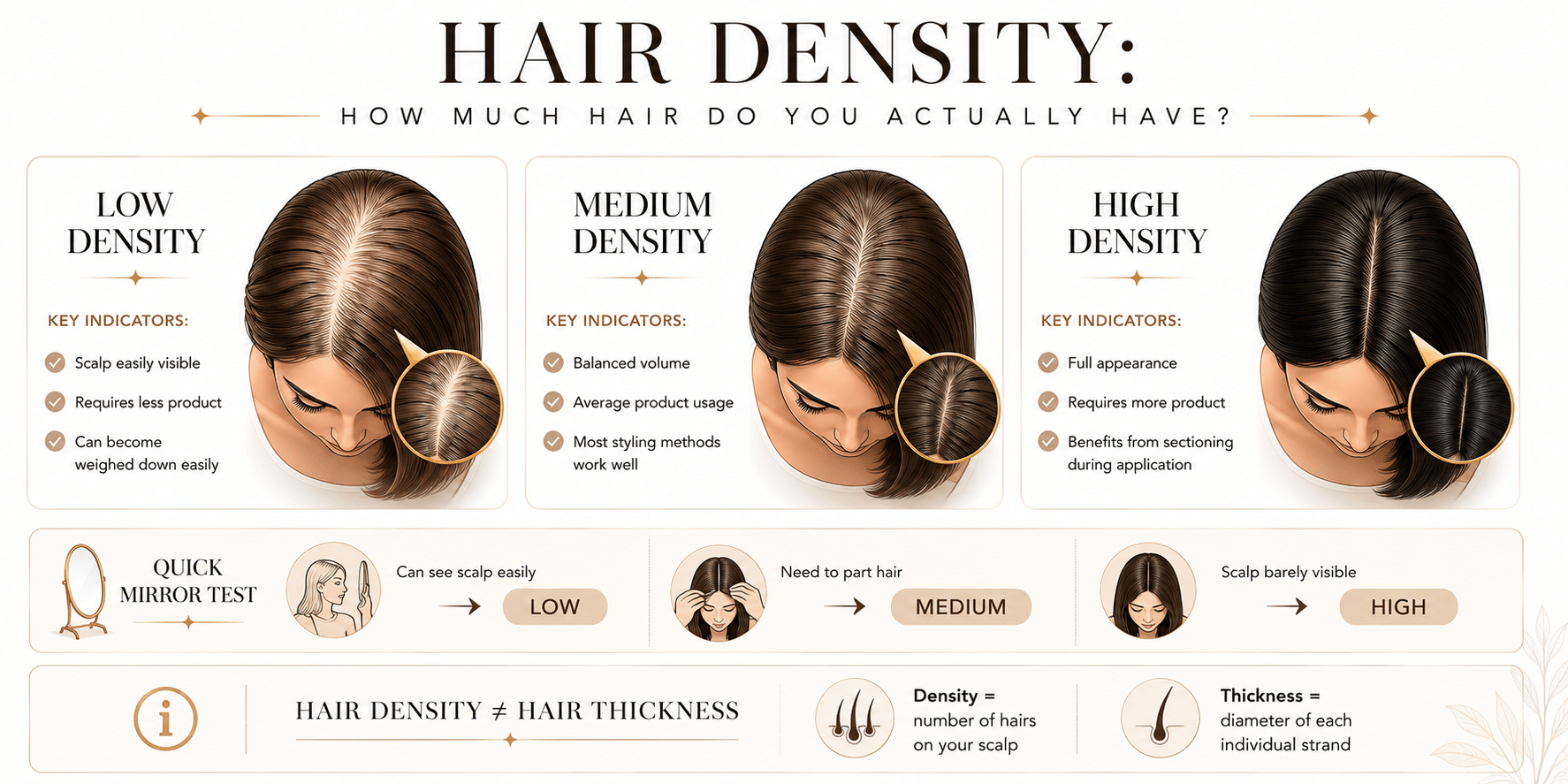
Hair Density: How Much Hair You Actually Have
Density is the number of individual strands per square inch on your scalp. It’s separate from thickness (the diameter of each strand) — you can have fine hair that’s very dense, or thick hair that’s sparse.
A simple mirror check: Pull all your hair to one side and look at how much scalp is visible. If you can clearly see your scalp without moving hair around, you have low density. If you have to part or shift hair to see scalp, you’re at medium. If your scalp is barely visible even when you try, that’s high density.
Density matters because it changes how much product you need, how long deep treatments take to saturate, and how you section your hair for even application. Someone with low density and heavy products will end up with flat, greasy-looking hair. Someone with high density using the same amount of conditioner as a low-density person is essentially under-treating half their head.
Scalp Condition: The Variable Nobody Talks About
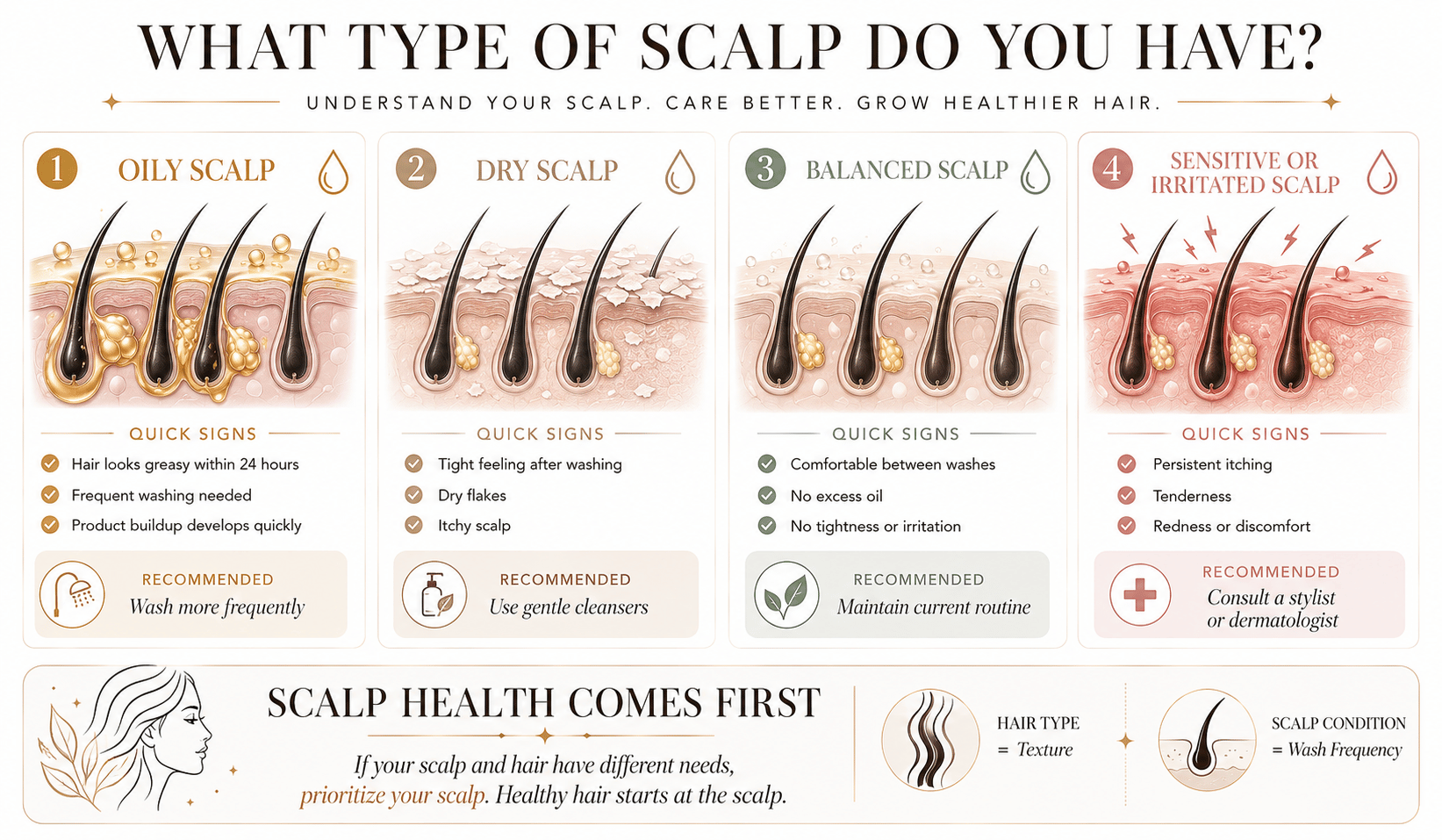
Your scalp is skin, not hair — and it has its own set of needs that most hair care guides ignore entirely. Scalp condition determines wash frequency more than hair type does.
Oily Scalp: Overproduces sebum. Hair looks greasy within 24 hours of washing. Often needs more frequent cleansing regardless of hair type — yes, even if you have curly or coily hair and every guide says to wash once a week.
Dry Scalp: Produces minimal oil. Can feel tight, flaky, or itchy — but flaking from a dry scalp is different from dandruff (which is a fungal issue). Dry scalps benefit from less frequent washing and gentler cleansers.
Balanced Scalp: Comfortable between washes. No excess oil or tightness. The easiest to maintain.
Sensitive or Irritated Scalp: Redness, itching, or tenderness that doesn’t go away with routine changes. This isn’t something a product swap fixes — it’s worth a conversation with a stylist or dermatologist, because it can signal anything from contact dermatitis to a more persistent condition.
 See alsoHair Gloss at Home: DIY Steps & Mistakes (Expert-Backed Guide)
The reason scalp condition matters so much: if you have a genuinely oily scalp and someone tells you to wash your Type 3 curls only once a week, you’ll end up with greasy roots, an itchy scalp, and potential buildup that affects how your curls form. Your scalp’s needs and your hair’s needs don’t always align, and when they conflict, scalp health wins — because everything grows from there.
Complete Guide
Hair Care Routine
by Hair Type
Scroll through each hair type below. Every routine is built around what your specific texture actually needs, with the steps broken into quick, readable actions.
Straight Hair
Straight hair reflects light beautifully and detangles easily, but oil travels root-to-tip fast. This routine is built around volume, clean roots, buildup control, and cuticle protection.
Routine Steps
Cleanse
Use lightweight, volumizing, or clarifying shampoo.
- Wash every 2-3 days, focusing shampoo on the scalp only.
- Let suds rinse through the lengths instead of scrubbing the ends.
- Double-shampoo if you use dry shampoo or styling products often.
Condition
Keep conditioner away from the roots.
- Apply conditioner only to the bottom third of the hair.
- Choose labels like weightless, volumizing, or fine hair.
- If roots get greasy fast, move conditioner even lower.
Treat
Clarify before adding more moisture.
- Use clarifying shampoo every 2-3 weeks to remove product residue.
- Skip weekly deep conditioning unless hair is color-treated or heat-damaged.
- If hair feels heavy after washing, buildup is often the issue.
Protect
Use heat protection every time.
- Apply heat protectant before blow-drying, straightening, or curling.
- Daily heat can damage the cuticle even on lower settings.
Style
Add lift without weight.
- Use dry shampoo, texture spray, or volumizing mousse.
- Avoid heavy serums, oils, and silicone-heavy products.
- Apply dry shampoo before hair looks greasy for best results.
Product Guide
- Volumizing shampoo
- Clarifying shampoo
- Lightweight conditioner
- Heat protectant spray
- Dry shampoo, texture spray, mousse
- Heavy oils and serums
- Silicone-rich formulas without clarifying
- Ultra-moisturizing conditioners
- Conditioner at the roots
- Root conditioning
- Skipping clarifying
- Using curly-hair products
- Heat tools without protection
Straight hair often needs buildup removal more than extra moisture. If it looks flat or greasy shortly after washing, clarify first.
Wavy Hair
Wavy hair needs definition and lightness at the same time. Too much moisture makes waves limp, while too little turns the texture into frizz.
Routine Steps
Cleanse
Use a gentle sulfate-free shampoo.
- Wash 2-3 times per week.
- Skip co-washing unless your waves are very dry.
- Traditional gentle cleansing keeps waves bouncy without flattening them.
Condition
Hydrate the ends without weighing down the roots.
- Apply conditioner from mid-lengths to ends.
- Use a medium-weight conditioner for regular wash days.
- Detangle in the shower with a wide-tooth comb.
Treat
Use masks carefully so waves do not collapse.
- Apply a hydrating mask every 1-2 weeks, focused on the ends.
- If waves lose shape over time, reduce conditioning before adding products.
- Over-conditioning can look like limp, shapeless hair.
Protect
Protect waves from heat and sun exposure.
- Use protectant before diffusing.
- For air-drying, use a lightweight leave-in with UV filters.
- Sun exposure can dry out wave definition over time.
Style
Apply light stylers, scrunch, then leave it alone.
- Use curl-enhancing mousse, sea salt spray, or light curl cream.
- Apply to damp hair, not soaking hair.
- Scrunch upward and air-dry or diffuse on low heat.
- Do not touch waves while they dry.
Product Guide
- Sulfate-free shampoo
- Medium-weight conditioner
- Hydrating mask for ends
- Curl mousse, sea salt spray
- Light leave-in with UV filters
- Ultra-rich daily conditioners
- Heavy curl creams at the root
- Co-washing as the only cleanser
- Touching hair while drying
- High-heat diffusing
- Following curly routines exactly
- Over-conditioning
- Heavy products near roots
- Touching waves while drying
Wavy hair is in the middle: too textured for straight-hair products, but not always curly enough for heavy curly-hair routines. Start with less product and build slowly.
Curly Hair
Curly hair is built around moisture retention. Every curve can let moisture escape, so the routine focuses on hydration, sealing, definition, and reducing frizz.
Routine Steps
Cleanse
Clean the scalp without stripping curls.
- Cleanse once or twice a week.
- Alternate gentle sulfate-free shampoo and co-wash.
- Shampoo the scalp and co-wash the lengths for balance.
- Clarify monthly if co-washing often.
Condition
Detangle only when hair is wet and slippery.
- Use a rich, moisture-heavy conditioner.
- Detangle with fingers or a wide-tooth comb while saturated.
- Use squish to condish: cup curls and squeeze upward.
- Never detangle curly hair dry.
Treat
Deep condition weekly, but watch the protein balance.
- Use a deep conditioning mask weekly.
- Prioritize masks during colder, dryer months.
- Use protein if curls are limp, mushy, or not bouncing back.
Protect
Leave-in conditioner comes before styling.
- Apply leave-in conditioner before styling.
- Add heat protectant on top if diffusing.
- If air-drying, leave-in is usually enough.
Style and Refresh
Style on soaking-wet hair for even definition.
- Apply curl cream or gel to soaking-wet hair.
- Scrunch upward, then plop with microfiber or a cotton T-shirt.
- Air-dry or diffuse on low heat without touching.
- Refresh with water-based spray and a small amount of styler.
- Sleep on silk or satin, or pineapple curls with a satin bonnet.
Product Guide
- Sulfate-free shampoo and co-wash
- Rich conditioner
- Water-based leave-in
- Curl cream or gel
- Microfiber towel or cotton T-shirt
- Satin pillowcase or bonnet
- Protein treatment when needed
- Dry detangling
- Regular terry towels
- Styling on damp instead of wet hair
- Touching curls mid-dry
- Adding moisture when curls are mushy
- Drying with regular towels
- Styling on damp hair
- Skipping protein
- Touching curls while drying
If curls are stiff or snapping, add moisture. If curls are limp, mushy, or stretching without bouncing back, add protein. The two problems can look similar but need opposite fixes.
Coily Hair
Coily hair is structurally fragile and moisture-hungry. The routine focuses on hydration sealing, breakage prevention, low manipulation, and protecting the hairline.
Routine Steps
Cleanse
Cleanse gently and keep shampoo on the scalp.
 See alsoWhy A Fresh Start Often Begins With Both A New Look And A New Place To Live
- Cleanse every 7-10 days.
- Use moisturizing co-wash as the main cleanser for lengths.
- Use sulfate-free shampoo on the scalp every 2-3 washes.
- Do not shampoo through the lengths.
Condition
Deep condition every wash day.
- Use a thick mask or reconstructor every wash.
- Leave it on for 15-20 minutes.
- Finger-detangle in sections, starting at the ends.
- Use a wide-tooth comb only after knots are loosened.
Treat
Pre-poo before cleansing to reduce stress.
- Apply coconut, avocado, or olive oil to dry hair before wash day.
- Focus on ends and lengths.
- Leave for at least 30 minutes before cleansing.
- Doing this overnight gives more protection.
Protect
Use LOC or LCO depending on porosity.
- Liquid: water or water-based leave-in.
- Oil: argan, jojoba, grapeseed, or another lightweight sealant.
- Cream: shea butter or thick styling cream.
- LOC often suits higher porosity; LCO can suit lower porosity.
Style and Refresh
Choose low-manipulation styles.
- Use loose twists, braids, braid-outs, and twist-outs.
- Avoid tight ponytails, daily slicked edges, and tension at the hairline.
- Refresh by lightly misting with water and reapplying a little cream or oil.
- Avoid fully rewetting and restyling between washes.
Product Guide
- Moisturizing co-wash
- Sulfate-free shampoo for scalp
- Thick deep conditioning mask
- Pre-poo oils
- Water-based leave-in
- Sealant oils and styling creams
- Satin bonnet or pillowcase
- Detangling without slip
- Dry brushing
- Daily tight ponytails
- Fully rewetting between washes
- Skipping pre-poo
- Shampoo on lengths
- Skipping pre-poo
- Tension styles at the hairline
- Detangling without slip
- Shampooing the lengths
- Full restyling between washes
Shrinkage is not damage. Type 4 coils can shrink dramatically because of healthy elasticity. Length retention comes from reducing breakage, not fighting the curl pattern.
How to Adjust Your Routine for Your Specific Conditions
Hair type gives you the framework. These modifiers fine-tune it. You might be a Type 3 with fine hair and an oily scalp — which means the standard “rich conditioner, wash once a week” advice for curly hair would leave you greasy and flat. Layer these adjustments on top of your type-based routine.
Fine Hair
Fine hair has a smaller strand diameter, which means it’s more easily weighed down by products. Use lightweight formulas across the board — conditioners, leave-ins, and stylers. Avoid butters, heavy oils, and “ultra-moisturizing” anything for daily use. Root-lifting spray or volumizing mousse applied at the scalp gives lift without buildup. When deep conditioning, keep the mask on the bottom half only and reduce the sit time by a few minutes.
Thick Hair
Thick hair (large strand diameter) can handle — and often requires — richer products. Section your hair when applying conditioner or masks to ensure even saturation; thick hair that’s only treated on the surface ends up dry in the interior layers. Expect longer drying times, and budget extra product. Anti-frizz serums and oils work well on thick hair without the weighing-down risk that fine hair faces.
Dry or Damaged Hair
If your hair is chemically processed, heat-damaged, or naturally very dry, the priority is protein-moisture balance. Hair that’s stiff, straw-like, and snaps easily needs moisture. Hair that’s limp, gummy, and stretches without bouncing back needs protein. Most damaged hair needs both — alternating between a protein treatment and a hydrating mask on a weekly or biweekly rotation. Reduce heat styling as much as possible, and always pre-poo before wash day to limit further moisture loss.
Oily Hair
Oily hair is almost always an oily scalp issue, not a hair issue. Wash frequency should follow your scalp’s needs — if it’s genuinely oily within 24 hours, washing daily or every other day with a gentle shampoo is fine, regardless of what your hair type “should” require. Apply dry shampoo at the roots before oil becomes visible — it works as prevention, not just a fix. Avoid touching your hair throughout the day, since your hands transfer oil to the strands.
Color-Treated Hair
Color molecules sit inside the cortex, and every time the cuticle opens, some of those molecules wash out. Use sulfate-free, color-safe shampoo exclusively. Rinse with cool or lukewarm water — hot water swells the cuticle and accelerates fade. A leave-in with UV protection is worth the extra step, especially in summer. If you notice significant fading between appointments, a color-depositing conditioner used once a week can extend vibrancy without a salon visit. Avoid chlorine, and rinse hair with clean water before entering a pool.
A Weekly Hair Care Schedule That Actually Works
Most guides say “wash 2-3 times per week” and leave it at that. Here’s what a structured week actually looks like — adjust wash days and frequency based on your hair type and scalp condition.
| Day | What to Do | Notes |
|---|---|---|
| Day 1 (Wash Day) | Shampoo scalp, condition lengths, deep conditioning mask or treatment | Main reset. Section hair for thorough application if density is medium or high. |
| Day 2 | Leave-in + style or air-dry | Freshest styling day. Apply protectant before any heat. |
| Day 3 | Scalp massage, light refresh if needed | Use fingertips (not nails) to stimulate circulation. Mist and scrunch curls/coils if needed. |
| Day 4 (Optional Second Wash) | Light cleanse or co-wash + conditioner | Straight/wavy/oily scalp types benefit from this. Curly/coily types can skip. |
| Day 5 | Dry shampoo at roots (if needed), refresh ends with a light oil or serum | Maintenance. Don’t over-apply. |
| Day 6 | Low-manipulation day — protective style, braid, or leave hair alone | Reducing handling reduces breakage. |
| Day 7 | Pre-poo or oil treatment before next wash day | Apply oil to dry hair the night before or morning of wash day. |
How to adapt this by type:
Type 1 and 2 (straight and wavy) typically need two wash days per week — Day 1 and Day 4. Type 3 (curly) can often skip Day 4 and wash once. Type 4 (coily) may stretch wash day to every 10 days, shifting the entire schedule forward. If your scalp runs oily regardless of type, add the second wash — scalp health overrides the schedule.
Hair Care Mistakes That Are Quietly Damaging Your Hair
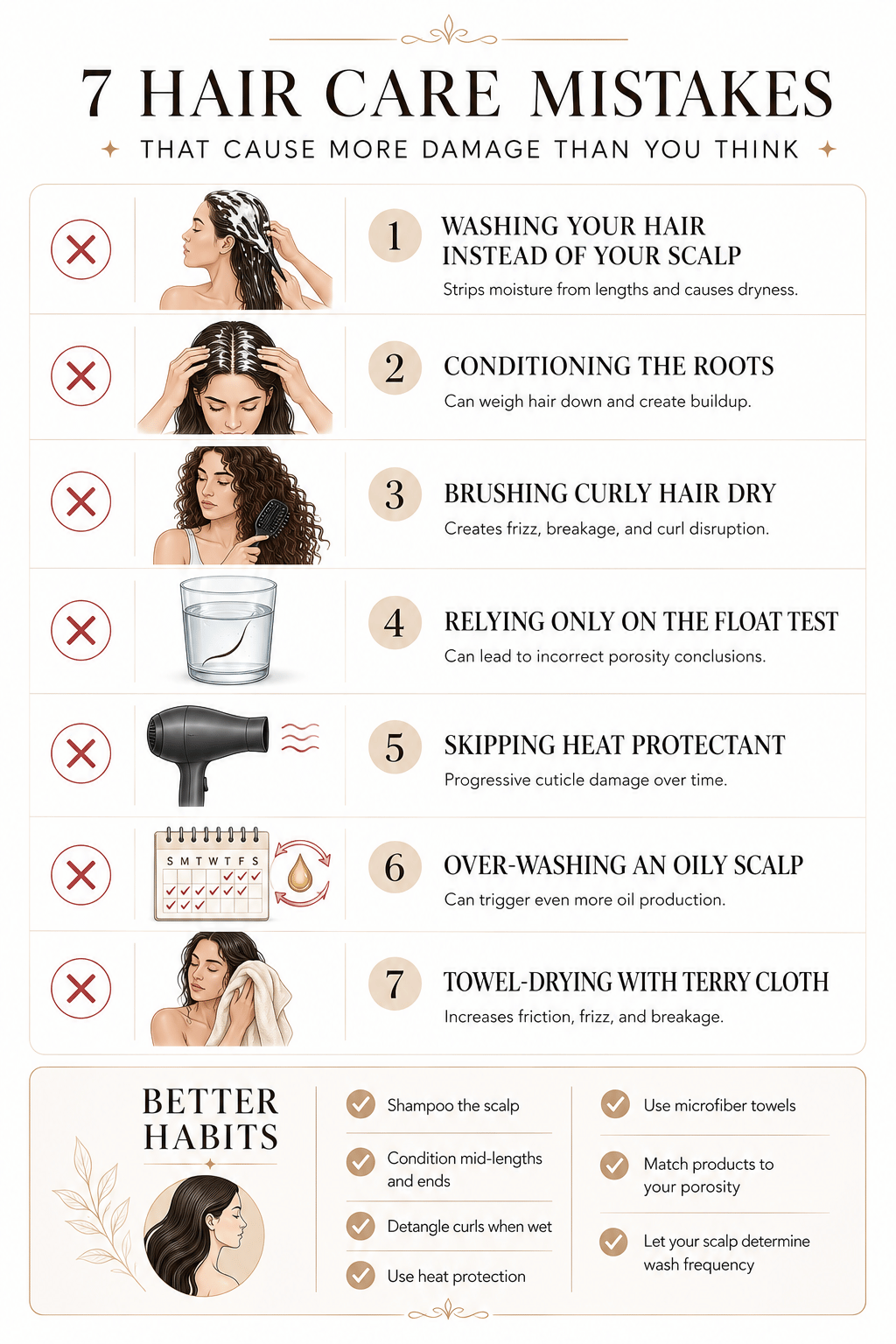
These aren’t obscure errors. They’re things most people do regularly without realizing the cumulative effect.
Washing your hair instead of your scalp. Shampoo is for the scalp. Lathering it through the lengths strips moisture from areas that don’t produce oil. Let the rinse water carry suds through the mid-lengths and ends — that’s enough.
Conditioning the roots. Conditioner at the scalp clogs follicles and weighs down the root area. It belongs on the mid-lengths and ends, where hair is oldest and driest. The only exception is very long Type 4 coily hair, where the entire strand may be equally dry.
Brushing curly or coily hair when it’s dry. Detangling curly and coily textures without water or conditioner as a buffer breaks the curl pattern, causes frizz, and snaps weaker strands. Always detangle wet, with conditioner in, working from ends to roots.
Treating the float test as a diagnosis. It’s popular because it’s simple, but relying on it alone can send you down a product path built on a shaky result — buying heavy sealants you don’t need, or skipping moisture your hair is actually starving for. A proper porosity assessment uses multiple signals, not one strand in a glass.
Skipping heat protectant because “it’s just a blow dryer.” Blow dryers can reach temperatures above 150°C. Without a protectant, that heat progressively damages the cuticle — not in one session, but over weeks and months of unprotected use. This applies to every hair type.
Washing more because your scalp feels oily. Over-washing strips the scalp’s natural oils, which triggers it to produce even more to compensate. That rebound oil cycle is why some people feel like their hair gets greasier the more they wash. If you’ve been washing daily, try spacing it out gradually — the scalp usually recalibrates within 2–3 weeks.
Towel-drying with a bath towel. Terry cloth is rough. Rubbing hair with a standard towel lifts the cuticle, causes frizz, and creates friction damage — especially on curly and coily textures. Use a microfiber towel or a cotton T-shirt instead. Squeeze, don’t rub.
FAQ
What is a good hair care routine?
A good routine includes five steps in order: cleanse the scalp, condition the lengths, treat specific concerns (like dryness or damage), protect from heat and environmental stress, and style. The products and frequency change based on your hair type, porosity, density, and scalp condition — there’s no single routine that works for everyone.
How often should I wash my hair?
It depends on your scalp, not your hair. Oily scalps may need washing every 1–2 days. Balanced scalps typically do well at 2–3 times per week. Dry scalps and coily hair types can often go 7–10 days. The right frequency is whatever keeps your scalp clean and comfortable without stripping your hair dry.
What is hair porosity?
Porosity is how open or closed your hair’s cuticle layer is, which determines how easily it absorbs and retains moisture. Low porosity means tightly sealed cuticles that resist moisture. High porosity means raised cuticles that absorb moisture fast but lose it quickly. Porosity affects which products work for you more than hair type does in many cases. For a full breakdown of how to test yours, see our hair porosity test guide.
Should conditioner go on roots or ends?
Ends. Conditioner is designed for the older, drier parts of the hair strand — mid-lengths to ends. Applying it to the roots can cause buildup, weigh down volume, and make the scalp feel greasy. The exception is very long coily hair where the entire strand is uniformly dry.
How often should I deep condition my hair?
Most hair benefits from deep conditioning once a week or every two weeks. Curly and coily types tend to need it weekly, especially in dry climates or winter. Straight and wavy types can usually go every 2–3 weeks unless the hair is color-treated or heat-damaged. If your hair starts feeling mushy or limp after deep conditioning, cut back — that’s moisture overload.
Does cutting hair make it grow faster?
No. Hair grows from the follicle at the scalp, and cutting the ends does not affect growth rate. What trimming does is remove split ends before they travel up the shaft, which prevents breakage and keeps your length looking fuller and healthier. Regular trims every 8–12 weeks are maintenance, not a growth strategy.
Is co-washing better than shampooing?
Neither is universally better — it depends on your hair type and scalp condition. Co-washing (using only conditioner to cleanse) works well for curly and coily hair that’s prone to dryness, because it cleanses without stripping moisture. But it doesn’t remove heavy buildup effectively, so even co-wash-only routines benefit from a clarifying shampoo every few weeks. Straight and wavy hair types usually need traditional shampoo to manage oil at the roots.
Your hair is doing something specific — and the right routine starts with understanding what that is. If you’d rather skip the trial-and-error, book a consultation at Salon 1150 in Austin. We’ll assess your type, porosity, and scalp condition in person and build a routine around what your hair actually needs — not what the internet guesses.